



Product introduction
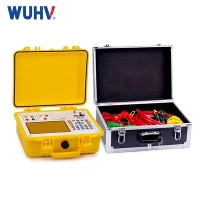
The UHV temperature rise test system is a highly integrated and intelligent electrical safety testing solution designed to verify the thermal performance and temperature rise stability of electrical equipment under rated current conditions.
It is used to accurately and efficiently measure temperature rise in equipment such as motors, transformers, switchgear, circuit breakers, relays, cables, and connectors when operated at rated or overload current levels.
The system monitors temperature increase at critical points including windings, contacts, terminals, and enclosures, and is used to assess whether electrical equipment can maintain thermal stability during long-term operation in compliance with IEC limits.
It is suitable for both type testing and engineering acceptance testing.

Product Parameters
Technical Parameters
| Input Voltage | Three-phase four-wire AC380V |
| Rated Frequency | 50Hz |
| Total System Power | 189kW |
| Total System Current | 287A |
| System Power Factor | cos²=0.8 |
Oil-Immersed Induction Voltage Regulator
| Rated Capacity | 63kVA |
| Output Voltage | 0-430V |
| Output Current | 0-166A |
| Waveform Distortion | ≤3% |
| Starting Voltage | ≤1% |
| Short-Circuit Impedance | ≤7% |
Dry-Type Current Booster
| Rated Capacity | 63kVA |
| Output Line Voltage | 10V |
| Output Current | 0-6300A |
| Rated Input Voltage | 380V |
| No-Load Loss | <4% |
| Rated Input Current | 166A |
| Short-Circuit Impedance | ≤5% |
| Cooling Method | Dry-type, air-cooled |
Core advantages of Temperature Rise Test System
1. High efficiency:
Save a lot of manual operations (manual pressure and flow regulation, meter reading, recording).
Automatically determine stable points without the need for manual observation and judgment.
24-hour continuous unmanned testing has become possible.
2. High precision and reliability:
The high-precision data acquisition card ensures accurate temperature and current measurement.
The stability criteria for software algorithms are objectively consistent, avoiding human errors.
Automatically record all raw data with strong traceability.
3. Security Enhancement:
Operators should stay away from high voltage and high current areas (remotely controlled by a computer).
Multiple software and hardware security protection mechanisms (overcurrent, overheating, timeout protection).
4. Convenient data management:
Electronic storage of all experimental data for easy retrieval, analysis, and comparison.
One click generation of standard reports saves a lot of report writing time.
5. Compliance with standards:
Built in mainstream testing standard processes and report templates to ensure compliance during the testing process.
6. Multifunctionality:
A device can usually adapt to the temperature rise test requirements of multiple electrical products (by replacing fixtures or adjusting configurations).
application And process of Temperature Rise Test System
Factory test and type test of motor (AC/DC).
Transformer (distribution, power) temperature rise test.
Temperature rise test of high and low voltage switchgear, distribution cabinet as a whole or components.
Temperature rise test of circuit breakers, contactors, relays and other electrical appliances.
Current carrying capacity and temperature rise testing of bus ducts, cables, and connectors.
Temperature rise verification in the field of new energy, such as charging stations and internal components of photovoltaic inverters.
Research institutes and quality inspection institutions conduct safety certification testing on electrical products.

Testing process is as follows
A rated or simulated load current is applied to the circuit under test
The equipment operates continuously under stable current conditions
The temperature gradually rises and reaches thermal equilibrium
The system records temperature variation curves and steady-state values
The temperature rise is evaluated against standard limit requirements


FAQS
What is the output current range?
UHV temperature rise test systems typically cover:
1000A
2000A
3000A
4000A
5000A
6000A
8000A and above (custom models available)
Does Temperature Rise Test System support long-duration continuous operation?
UHV systems are generally designed for:
8 / 12 / 24 hours continuous operation
Stable long-term current output
Strong thermal equilibrium capability
Reliable performance under high-current conditions
How is temperature measured?
UHV systems usually combine multiple temperature measurement methods:
Thermocouples (mainstream method)
PT100 platinum resistance sensors
Infrared temperature measurement (auxiliary monitoring)
Wireless temperature modules (high-end configuration)
Measurement points typically include:
Contact joints
Busbar connections
Circuit breaker contacts
Enclosures and key heating areas
Does Temperature Rise Test System support multi-channel temperature acquisition?
Yes.
UHV temperature rise test systems typically provide:
16 / 32 / 64 / 128 synchronized channels
Real-time multi-point temperature display
Automatic recording of temperature rise trends
Multi-point comparison analysis
Automatic test data logging
Which standards does it comply with?
UHV systems follow widely adopted international standards:
IEC 61439 (low-voltage switchgear assemblies)
IEC 62271 (high-voltage switchgear)
IEC 60068 (environmental and thermal testing)
IEEE temperature rise standards for switchgear
Evaluation is based on:
Whether steady-state temperature rise meets limits
Whether contact temperatures exceed thresholds
Temperature-corrected results under ambient conditions
Thermal consistency across all measurement points
How is current stability ensured?
UHV systems use industrial-grade current regulation architecture:
Thyristor / IGBT power control technology
Closed-loop current feedback control
Automatic steady-state compensation algorithms
Dynamic load regulation mechanism
This ensures minimal current fluctuation during long-duration testing.
Is Temperature Rise Test System suitable for on-site substation testing?
Yes.
UHV temperature rise test systems are designed as:
Split-type structure for easy transportation
Industrial cabinet design
Suitable for substation field deployment
Applicable to temporary test environments
Does it support automatic testing and data recording?
Yes.
The temperature rise test system provides:
Automatic current ramping and stabilization
Automatic temperature rise curve recording
Real-time data storage
Traceable test process
Automatic generation of IEC-style reports
Does temperature rise test system include safety protection functions?
UHV systems are typically equipped with multiple protections:
Overcurrent protection
Overtemperature protection
Short-circuit protection
Cooling system alarm (air/water cooling)
Automatic emergency shutdown
Does it support FAT and SAT testing?
Yes.
UHV temperature rise test systems are widely used for:
Factory Acceptance Test (FAT)
Site Acceptance Test (SAT)
Type tests
Project delivery verification
Quality consistency testing
What is included in the system delivery?
Standard UHV delivery typically includes:
High-current generation system
Control and regulation system
Multi-channel temperature acquisition system
Dedicated test software
Calibration and factory test reports
Technical training and on-site support
What is the difference between temperature rise testing and primary injection testing?
Temperature rise testing focuses on long-term thermal stability (hour-level operation)
Primary injection testing focuses on instantaneous protection operation (second-level response)
In essence:
Temperature rise test = thermal load verification
Primary injection test = protection system verification
We are a professional temperature rise test system manufacturers in China.We can provide the best professional temperature rise test system for sales and competitive price. If you are looking for temperature rise test system supplier, we are a good choice.
Contact us to get temperature rise test system price.
Hot Tags: temperature rise test system, China temperature rise test system manufacturers, suppliers, factory


