


Product introduction
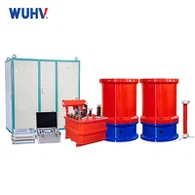
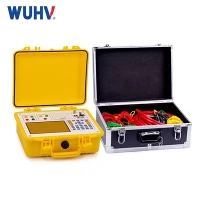
The UHV-105 CT/PT Comprehensive Tester is a fully automated instrument designed for CT/PT characteristic testing, specifically for relay protection and high-voltage insulation applications. It can perform multiple tests, including CT/PT volt-ampere characteristic tests, ratio and polarity tests, polarity verification tests, primary current injection tests, and AC withstand voltage tests. The instrument automatically calculates key parameters such as knee-point voltage and current values, ratio errors, and 5% and 10% error curve values.

Product Parameters
| Major Technical Parameters | |
| Operational Power Supply | AC220V±20V, 50~60Hz |
| Equipment Power Supply Output Waveform | Sine Wave |
| Single Machine Output Voltage of Excitation Characteristic | 0~1200V |
| Excitation Output Current Set | 0~20A |
| Single Machine Output Current of Transformation Ratio Test | 0~1000A |
| CT ratio measurement range | 5~25000A/5A(5000A/1A) |
| PT ratio measurement range | 1~500KV |
| Error | ≤0.5%(0.2%*Reading+0.3%*Range) |
| Operating Temperature | -10℃~+40℃ |
| Relative Humidity | <90RH% |
| Altitude | ≤1000m |
| Overall Dimension(Length*Width*Height) | 450*280*260(mm) |
| Weight | ≤30Kg |
points for attention

Fully Automated Tester: Simply set the maximum output voltage and maximum output current; the instrument will automatically ramp voltage or current from zero to perform various tests.
Comprehensive Functionality: Capable of testing CT/PT volt-ampere characteristics, ratio and polarity, 10% error curves, phase angle error, and ratio error.
Voltage/Current Boost & Hold Function: Features a voltage boost and hold function for metering verification and secondary AC withstand voltage tests, as well as a current boost and hold function for secondary circuit inspections.
True RMS Sampling: All voltage and current signals are sampled using true RMS measurement. Calibration must be performed using a true RMS meter.
Single Power Supply: Requires only a single AC 220V input power supply, making operation convenient. This eliminates the outdated requirement from some manufacturers' instruments that rely on a 380V power supply to meet technical specifications.
USB Data Storage: Test data can be saved via USB to a PC for processing, display, printing, storage, and report generation (including data and curves), greatly facilitating report preparation.
Non-Contact Testing & Enhanced Safety: Fully computerized system. Once configured, testing runs automatically without manual intervention. Operators can remain away from high-voltage circuits, ensuring personnel safety.
Touchscreen Operation: Equipped with a large 8-inch high-resolution (1024 × 768) color touchscreen LCD. Includes a built-in printer for immediate printing of curves and test data.
High-Capacity Data Storage: Stores up to 3000 sets of test data. Data is permanently retained and will not be lost during power outages.


FAQS
1. What does a CT PT Tester measure?
A CT PT Tester is used to evaluate the electrical performance of current transformers (CTs) and potential transformers (PTs).
Key tests include:
Transformation ratio
Polarity
Excitation characteristics
V-I (voltage-current) curve
Winding resistance
Ratio error and phase displacement
Burden capacity
📌 Purpose:
To verify whether instrument transformers meet metering and protection requirements.
2. What is the difference between CT and PT testing?
✔ CT (Current Transformer)
High current input
Focus on ratio accuracy, saturation characteristics, and error performance
✔ PT (Potential Transformer)
Voltage-based testing
Focus on ratio, polarity, ratio error, and phase angle
👉 UHV systems support automatic CT/PT mode recognition.
3. Which standards are supported?
IEC 60044 (legacy standard)
IEC 61869 (modern instrument transformer standard)
IEEE C57 series
GB/T 20840
👉 UHV systems are designed for IEC and IEEE dual-standard compliance.
4. What is the testing principle?
✔ CT testing:
Inject current into secondary side
Measure excitation current and response curve
Calculate ratio error and saturation point
✔ PT testing:
Low-voltage injection
Compare input/output voltage ratio
Analyze phase displacement
5. Measurement range and accuracy
Typical UHV configuration:
Current output: 0–1000A (or higher models available)
Voltage output: 0–120V / 0–300V
Accuracy:
Ratio error ≤ ±0.05%
Phase angle ≤ 2 minutes
Hot Tags: ct pt comprehensive tester, China ct pt comprehensive tester manufacturers, suppliers, factory