

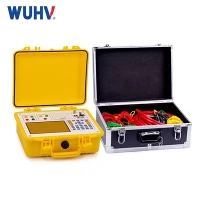


Product introduction
UHV Wide Voltage Range Battery Charge and Discharge Tester is a specialized instrument designed for testing the performance of various battery types (lead-acid, lithium-ion, NiMH, NiCd, supercapacitors, etc.) under wide voltage ranges. It integrates multiple functions such as charging, discharging, cycle testing, capacity testing, internal resistance measurement, data logging, and analysis. It is an indispensable tool for battery R&D, production quality control, performance evaluation, system integration, and maintenance.

Key Technologies & Performance Specifications
High Accuracy: Voltage/current measurement accuracy typically ±0.05% FS or better; capacity accuracy ±0.1% or better.
High Stability: Maintains stable output and measurement during prolonged testing.
High Dynamic Response: Rapidly responds to mode changes and current/power step changes.
High Sampling Rate: Quickly captures instantaneous voltage/current changes.
Robust Cooling: Efficient cooling systems (air/water) essential for reliable high-power operation.
Multi-level Safety Protection: Over-voltage, under-voltage, over-current, over-temperature, reverse polarity, short-circuit, over-capacity protection, etc., ensuring test safety.
Communication Interfaces: Typically includes RS232/RS485, USB, LAN (Ethernet), CAN for remote control, data transfer, and integration into automated test systems.
Modular Design (Some High-end/High-power Models): Power scalability achieved by paralleling modules for flexibility.
Product Function
Constant Current Charge and Discharge: It performs constant current discharge at a set value by continuously regulating the discharge current, using the battery as the discharge load in offline mode. It also supports charging with adjustable voltage and current.
Automatic Test Termination: The Battery Charge and Discharge Tester manufacturer automatically stops discharging when the battery terminal voltage or individual cell voltage falls to the set lower limit, or when the set discharge time or capacity is reached.
Wireless Cell Voltage Monitoring: It features wireless relay access for single battery voltage monitoring, with each wireless monitoring module capable of monitoring up to 12 individual cells simultaneously, ensuring simple, safe, and accurate data collection.
Comprehensive Protection: It includes perfect protection functions with audible and visual alarms, clear interface prompts, and PTC ceramic resistors to avoid red-hot phenomena, making the entire discharge process safer.
Data Management: The discharge process data is stored in the device's memory and can be archived to a USB drive via the data interface. The upper computer software analyzes data and generates required curves and reports.
Wide Voltage Range: It features a 10–600V wide voltage design, with a single machine capable of meeting charge and discharge test requirements for various voltage grade battery packs.
Technical Parameters
|
Working mode |
can be used single machine, can be used simultaneously, can be remote control and status monitoring |
|||
|
Charging voltage |
10~300V |
10~600V |
||
|
Charging current |
0~40A |
0~60A |
0~20A |
|
|
Discharge voltage |
10~300V |
10~600V |
||
|
Discharge current |
10~19V:0~50A; 19~180V:0~100A; 180~300V:0~50A; |
10~19V:0~50A; 19~180V:0~100A; 180~300V:0~50A; |
10~19V:80A ; 19~180V:120A; 180~300V:80A; 300~600V:50A; |
|
|
Current accuracy |
1% |
|||
|
Voltage accuracy |
0.5% |
|||
|
Monomer voltage accuracy |
0.2% |
|||
|
Monomer voltage |
0.500V~16.00V(resolution 1mv) |
|||
|
Charge discharge time |
0 ~ 99 hours and 59 minutes |
|||
|
Power supply |
AC:220V/380V |
|||
|
Dimension |
461 x 225 x 390mm3 |
|||
|
Weight |
One charger: 17.5kg; Two chargers: 20kg |
|||
|
Handling way |
industrial universal wheel |
|||
Work Environment
|
Heat dissipation |
forced air cooling |
|
Temperature |
working range: -5 ~ 50℃ storage temperature: -40 ~ 70℃ |
|
Humidity |
relative to humidity0 ~ 90% (40±2℃) |
|
Altitude |
rated altitude: 4000 m |
|
Noise |
﹤60dB |
Working Power Supply
|
Voltage |
single-phase three-wire system: 220V AC (- 20% ~ +30%), frequency :45 ~ 65Hz |
|
Withstand voltage test |
input - housing: 2200V DC 1min |
|
input-output: 2200V DC 1min |
|
|
output - housing: 700V DC 1min |
|
|
Security |
meet EN610950 |
Wiring
|
AC input |
Gb socket, suitable for 1 ~ 1.5mm2cable |
|
DC output |
instrument 25 mm2Cable quick connect plug (red positive black negative) |
Primary Application Fields
Battery Manufacturing & QC: Final product testing, batch sampling, type testing.
Battery R&D: Evaluating performance, cycle life, safety of new materials/structures/processes.
EV/Power Tool Industry: Testing performance, consistency, cycle life, duty cycle simulation of battery cells, modules, packs.
Energy Storage System (ESS) Integration & Operation: Testing capacity, efficiency, cycle life, consistency of battery clusters/systems; system maintenance & diagnostics.
Telecom/Data Centers/UPS: Testing performance and health of backup power batteries.
Battery Recycling & Second-life: Assessing residual value and usability of retired batteries.
Research Institutes & Testing Labs: Battery performance research, standards compliance testing.
Frequently Asked Questions
|
Q: Why is battery charge-discharge testing necessary? A: Through testing, it is possible to: Determine whether the actual battery capacity meets the specified standards Identify batteries with capacity degradation Prevent backup power failures in advance Extend battery service life Improve the reliability of the power supply system |
|
Q: Can the battery charge-discharge tester determine whether a battery needs to be replaced? A: Yes. Through capacity testing, discharge curve analysis, and performance data evaluation, it can determine whether the battery has experienced capacity degradation, aging, or performance abnormalities, thereby assisting in the decision of whether replacement is necessary. |
|
Q: Why is a battery charge-discharge tester needed in substations? A: The DC system in substations relies on batteries to provide backup power. Through charge-discharge testing, it can be confirmed whether the battery bank has the reliable power supply capability required during power outages or emergency situations. |
|
Q: Why do batteries require periodic discharge testing? A: Under long-term floating charge conditions, batteries may experience issues such as capacity degradation and plate sulfation. Regular discharge testing can identify potential problems in advance. |
Wuhan UHV Power Technology Co.,Ltd., is a professional manufacturer and supplier of high-voltage power testing equipment in China.We have our own factory with over 10 years of production experience,and we can provide the best professional Battery Charge and Discharge Tester for sales and competitive price.We offer free consulting service, one year warranty, and adopt various methods such as email communication, video calls, aiming to solve any after-sales problems in a timely manner.
Hot Tags: wide voltage range battery charge and discharge tester, China wide voltage range battery charge and discharge tester manufacturers, suppliers, factory, battery capacity discharge tester, battery runtime tester kit, battery discharge and voltage curve analyzer, battery discharge with temperature sensor, battery cell analyzer, battery capacity test interval recommendations


