

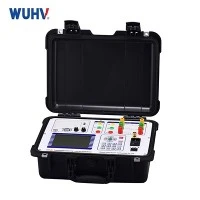


## **1. What is an AC Hipot?**
An **AC Hipot** (High Potential) tester is a **high-voltage alternating current insulation testing device** used to apply a controlled AC voltage to an electrical component, cable, or system to verify the insulation's ability to withstand over-voltage stress without breakdown.
**Key points:**
* Operates at **50 Hz or 60 Hz** (power frequency) or other specified AC frequencies.
* Continuously reverses polarity, so it stresses the insulation in both directions.
* Leakage current includes both **capacitive charging current** and **resistive leakage current**.
---
## **2. Purpose**
The main purposes of AC Hipot testing are:
1. **Dielectric Withstand Test** – ensure the insulation can safely operate under and beyond its rated voltage.
2. **Quality Control** – verify factory manufacturing quality of insulation systems.
3. **Commissioning Tests** – ensure equipment passes acceptance criteria before service.
4. **Periodic Maintenance** – detect insulation deterioration before failure.
---
## **3. Applications**
AC Hipot testers are used for:
* **Power transformers** (factory and site testing)
* **High-voltage cables** (especially when using resonant or VLF AC Hipot for long lengths)
* **Switchgear & busbars**
* **Motors and generators**
* **Capacitors**
* **Bushings**
* **Aerospace wiring and harnesses**
* **Electrical panels and assemblies**
* **Factory type and routine tests for HV equipment**
---
## **4. How to Use an AC Hipot – Step-by-Step**
> ⚠ Always follow the specific standard (IEC, IEEE, ANSI) and the equipment manufacturer's instructions.
**Step 1 – Preparation**
* Isolate and de-energize the test object.
* Ground and discharge the object before connecting.
* Place warning barriers and signs.
* Verify test equipment calibration.
**Step 2 – Connection**
* Connect the AC Hipot's **high-voltage lead** to the conductor/terminal under test.
* Connect the **return lead** to the grounded side of the test object.
* Install a measuring device if not built-in (voltage and leakage current meters).
**Step 3 – Testing**
1. Start at **zero voltage**.
2. Increase voltage gradually at a controlled ramp rate.
3. Observe leakage current and waveform stability.
4. Reach the specified test voltage (typically 1.5×–2× rated voltage or per standard).
5. Hold for the specified duration (commonly 1 minute for factory routine tests, up to 30–60 minutes for long-term tests).
6. Monitor for breakdown or excessive leakage.
**Step 4 – Shutdown**
* Reduce voltage smoothly to zero.
* Disconnect the high-voltage lead.
* Ground and discharge the test object before handling.
---
## **5. Advantages of AC Hipot Testing**
* **Simulates real operating conditions** - polarity reverses as in service.
* **No insulation charging effects** - voltage is continuously alternating, so no need for long discharges.
* **Can detect certain defects that DC tests miss** (e.g., voids that respond to AC stress).
* Fully compliant with most international factory test standards.
---
## **6. Limitations**
* Requires more **input power** than DC testing - especially for long capacitive loads.
* Portable AC Hipots are limited in voltage and capacity; for large capacitive objects, a **resonant AC system** is often required.
* Leakage current readings include capacitive charging current, so separating resistive leakage is harder than in DC testing.
---
## **7. AC Hipot – FAQs**
**Q1: How is an AC Hipot different from a DC Hipot?**
**A:**
* AC Hipot stresses insulation in both polarities, just like in service, and doesn't leave a residual charge.
* DC Hipot applies steady voltage in one direction and measures leakage more precisely but may cause space charge issues in some insulation.
---
**Q2: Can I use a standard transformer for AC Hipot testing?**
**A:**
Not safely. AC Hipot testers include **precision voltage control, metering, and safety interlocks** designed for dielectric testing.
---
**Q3: What determines the test voltage?**
**A:**
Usually defined by IEC, IEEE, or manufacturer specs. Often 1.5×–2× the equipment's rated voltage for a set time.
---
**Q4: How long should I maintain the test voltage?**
**A:**
Commonly 1 minute for factory routine tests. Some type tests require 5 minutes or more. Field withstand tests may be shorter to avoid unnecessary stress.
---
**Q5: Can AC Hipot detect partial discharge (PD)?**
**A:**
Yes - if integrated with PD measuring equipment, the AC Hipot can provide the high voltage while PD detectors monitor for discharge activity.
---
**Q6: Can AC Hipot be dangerous to the test object?**
**A:**
Yes - overvoltage or excessive duration can damage insulation. Always follow the recommended levels and time limits.
---
**Q7: Do I need to discharge after AC Hipot testing?**
**A:**
Generally, no - because AC voltage alternates, it doesn't leave a static charge like DC. However, large capacitive objects (e.g., cables) should still be grounded after the test to remove any residual.
---
**Q8: What types of AC Hipot testers are available?**
**A:**
* **Power-frequency AC Hipot** (standard transformers)
* **Series Resonant AC Hipot** (for large capacitive loads)
* **VLF AC Hipot** (for very long cables with reduced power needs)
---
**Q9: Which standards apply to AC Hipot testing?**
**A:**
* **IEC 60060-1 & 60060-3** – High-voltage test techniques
* **IEC 60502 / 60840 / 62067** – Power cable tests
* **IEEE Std 4** – AC high-voltage test techniques
* **ANSI C37** – Switchgear testing
---
**Q10: Why choose AC Hipot over DC Hipot for modern XLPE cables?**
**A:**
AC Hipot (especially VLF) is preferred for XLPE cables because DC can cause space charge buildup, leading to premature aging or failure.