

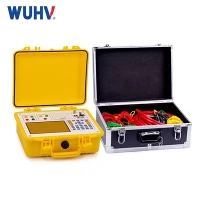


## **1. What is a VLF Hipot Tester?**
A **VLF Hipot Tester** is a **very low frequency (typically 0.1 Hz or lower) AC high-voltage testing device** used to test the insulation of large capacitive loads - especially long high-voltage power cables - using a fraction of the power required by standard power-frequency AC testing.
**Why "Very Low Frequency"?**
* Power frequency AC (50/60 Hz) requires enormous reactive power for long cables.
* At **0.1 Hz**, the capacitive reactance is much higher, so the charging current is much smaller - meaning the test set can be portable and lower power.
* The waveform is sinusoidal or cosine-rectangular, still alternating, so it avoids DC-related space charge problems.
---
## **2. Purpose**
The main purposes of VLF Hipot testing are:
* **AC Withstand Test for long capacitive loads** (XLPE, EPR cables).
* **Acceptance testing** after installation or repair.
* **Maintenance testing** to find insulation weakness before failure.
* Provide AC stress **without massive test transformers**.
* Comply with modern cable testing standards that discourage DC Hipot on extruded cables.
---
## **3. Applications**
VLF Hipot testers are widely used for:
* **Medium-voltage (MV) and high-voltage (HV) XLPE & EPR power cables**
* **Paper-insulated lead-covered (PILC) cables** (when AC testing is preferred)
* **Capacitor banks**
* **Large rotating machines** (motors/generators with long windings)
* **Subsea and underground cable systems**
* **Periodic maintenance in utility networks**
---
## **4. How to Use a VLF Hipot Tester – Typical Procedure**
> ⚠ Always follow IEEE 400, IEC 60502, or local utility standards for test levels and times.
**Step 1 – Preparation**
* De-energize, isolate, and ground the test object.
* Visually inspect terminations and connections.
* Rope off the test area and display warning signs.
* Verify tester calibration and set test parameters.
**Step 2 – Connection**
* Connect the VLF Hipot's **HV output** to the conductor under test.
* Connect the **return/ground** to the shield or grounded point.
* Ensure proper grounding for safety.
**Step 3 – Testing**
1. Start with zero voltage.
2. Ramp up to the specified test voltage (per standard).
3. Apply the voltage for the required duration (typically 15–60 minutes for acceptance; 5–15 minutes for maintenance).
4. Monitor leakage current and waveform.
5. Watch for insulation breakdown (sudden current increase).
**Step 4 – Shutdown & Discharge**
* Reduce voltage to zero.
* Use the tester's discharge function or an external resistor to drain the stored charge.
* Apply a visible ground to confirm safety.
---
## **5. Advantages of VLF Testing**
* **Portable** - small size compared to power-frequency AC test sets.
* **Low power requirement** - can test very long cables with small equipment.
* **Safer for modern XLPE/EPR insulation** than DC Hipot.
* **Complies with modern standards** for cable testing.
* Can integrate with **partial discharge (PD)** and **tan δ (dissipation factor)** measurements for diagnostic testing.
---
## **6. Limitations**
* Only suitable for **capacitive loads** - not for highly inductive equipment.
* Test frequency is much lower than service frequency - primarily a withstand test, not full operational simulation.
* Not as effective for detecting certain mechanical defects as online monitoring.
---
## **7. VLF Hipot Tester – FAQs**
**Q1: What frequency is used in VLF testing?**
**A:** Commonly **0.1 Hz**, but can be as low as 0.01 Hz depending on load size.
---
**Q2: Why not just use DC Hipot for cables?**
**A:** DC can cause **space charge accumulation** in modern polymer insulation (XLPE/EPR), leading to premature breakdown. VLF alternates polarity and avoids this.
---
**Q3: How do I select the correct test voltage?**
**A:** Follow standards:
* **IEEE 400.2** for VLF testing of shielded power cables.
* **IEC 60502-2** for MV cables.
Voltage is often 2–3× the cable's phase-to-ground operating voltage for acceptance tests; lower for maintenance.
---
**Q4: How long should the VLF test last?**
**A:**
* Acceptance tests: 15–60 minutes (depending on standard and voltage level).
* Maintenance tests: often shorter, around 5–15 minutes.
---
**Q5: What waveform should I use - sine or cosine-rectangular?**
**A:**
Both are used. Sine wave is preferred for PD and tan δ diagnostics. Cosine-rectangular is more efficient for withstand testing.
---
**Q6: Can I use a VLF Hipot on transformers or motors?**
**A:**
Possible for large windings with high capacitance, but most VLF testers are optimized for cables.
---
**Q7: Is discharging after VLF testing necessary?**
**A:**
Yes - the test object behaves like a large capacitor and stores a dangerous charge. Always discharge fully before touching.
---
**Q8: Can VLF Hipot testing be combined with diagnostics?**
**A:**
Yes - modern systems can perform **withstand + PD + tan δ** in one test session, giving both pass/fail and condition assessment.
---
**Q9: Which standards cover VLF testing?**
**A:**
* **IEEE 400.2** – Field testing of shielded power cables with VLF voltage.
* **IEC 60502-2** – Power cable testing requirements.
* **IEEE 48** – Cable termination testing.
---
**Q10: What happens if the insulation fails during the test?**
**A:**
Voltage collapses, leakage current spikes, and the tester trips. This indicates a breakdown point, which must be located and repaired before retesting.