

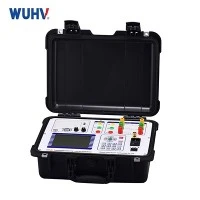


1. High Voltage Cable Testing
Why Resonant Testing?
Power cables, especially underground and submarine cables, have high distributed capacitance.
Applying high AC voltage directly requires enormous power, which is inefficient.
Resonant systems compensate for capacitive currents, requiring only power to cover losses.
What is Tested?
AC withstand voltage: The cable insulation must withstand the rated voltage plus safety margin.
Partial Discharge (PD) detection: Early insulation defects can be detected during the test.
Tan delta (loss angle) measurement: To assess insulation quality.
How it Works:
The cable acts as the capacitive part CCC.
The resonant reactor LLL is adjusted to resonate at the test frequency (usually 50 or 60 Hz).
At resonance, voltage across the cable is magnified while the input power remains manageable.
Voltage and current sensors monitor the test for safety and results.
Benefits:
Saves energy and reduces power source size.
Provides sinusoidal voltage for realistic stress conditions.
Enables field and factory tests, even for very long cables.
2. Gas-Insulated Switchgear (GIS) Testing
Why Resonant Testing?
GIS components have high inherent capacitance due to close conductor spacing.
Direct application of test voltage is inefficient without compensation.
What is Tested?
AC withstand test of GIS assemblies and components.
Detects insulation weaknesses and manufacturing defects.
How it Works:
GIS capacitance forms part of the resonant circuit.
Reactor tuned to resonate with GIS capacitance.
Voltage amplified at resonance stresses insulation.
Benefits:
Compact and portable test setups possible.
Reduced power consumption.
Accurate simulation of service voltage conditions.
3. Transformer Winding Testing
Why Resonant Testing?
Large transformers have significant inter-winding and stray capacitances.
Direct AC testing would need a high-power source, which is costly.
What is Tested?
High-voltage insulation strength of transformer windings.
Detects insulation faults or weaknesses.
How it Works:
Transformer windings and test circuit capacitance form resonant LC circuit.
Resonance allows high voltage application at low power input.
Frequency and inductance adjusted for precise resonance.
Benefits:
Efficient testing of large transformers.
Safe voltage control and monitoring.
Can simulate actual operating stress conditions.
4. Rotating Machines (Motors and Generators)
Why Resonant Testing?
Stator windings have capacitive characteristics.
Resonant testing provides controlled AC voltage stress for insulation assessment.
What is Tested?
Stator winding insulation integrity.
Early detection of insulation breakdown potential.
How it Works:
Similar resonance principle applied to stator capacitance.
Adjustable reactor and frequency allow matching resonance condition.
Benefits:
Helps in predictive maintenance.
Avoids over-stressing insulation.
Portable resonant test sets available for on-site testing.
5. Capacitors and Insulation Material Testing
Resonant testing evaluates dielectric strength and loss under AC voltage.
Useful for quality control and acceptance testing of capacitors and insulating materials.
6. Partial Discharge (PD) Testing
PD detection often combined with resonant test systems.
High voltage stress from resonance helps reveal defects that cause PD.
PD measurement during resonance provides early warning of insulation problems.
Practical Considerations for Using Resonant Test Systems
| Factor | Details |
|---|---|
| Tuning Accuracy | Precise tuning of inductance critical for resonance |
| Frequency Range | Test frequency typically 50/60 Hz; some systems allow 20–300 Hz for tuning flexibility |
| Measurement | Requires high-precision voltage and current sensors |
| Safety | High voltages and currents involved; requires proper interlocks and monitoring |
| Power Supply | Smaller than direct test systems but must handle loss compensation |
| Control | Automated systems adjust reactor and frequency to maintain resonance |
Standards Commonly Referenced
IEC 60060-3: High voltage test techniques – Resonant test systems
IEC 60840 & IEC 62067: Power cable testing
IEC 62271: High-voltage switchgear and controlgear (for GIS)
IEEE 400.3: Field testing of extruded cable systems
Summary Table of Applications and Benefits
| Application | Why Resonant Test System? | Main Benefit |
|---|---|---|
| HV Cables | High cable capacitance, long length | Energy efficient, precise voltage control |
| GIS | High capacitance due to compact design | Reduced power input, compact test setup |
| Transformers | Large capacitance, high power requirements | Safe, efficient testing of winding insulation |
| Motors & Generators | Capacitive stator windings | Portable, effective insulation testing |
| Capacitors & Materials | Dielectric testing under AC voltage | Accurate quality control |
| Partial Discharge | Detect early insulation defects | Combines voltage stress and PD measurement |