

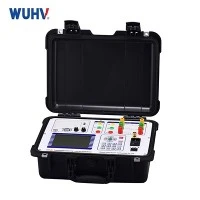


### **What is a High Voltage Tester?**
A **High Voltage Tester** is a device designed to measure and test the **dielectric strength** (ability to resist electrical breakdown) and **insulation resistance** of electrical components and systems. It works by applying a high-voltage signal to an electrical system or component, typically in the range of **kilovolts (kV)**, to ensure that the insulation is capable of withstanding high-voltage conditions without failure.
These testers are used to verify that electrical systems, cables, transformers, switchgears, and other equipment can safely operate at their designed voltage levels without breakdowns, short circuits, or electrical hazards.
---
### **Purpose of a High Voltage Tester**
1. **Insulation Testing**:
The primary purpose of a high voltage tester is to assess the **quality of insulation** in electrical systems and components. It checks whether the insulation can safely withstand the operating voltage without failure. A breakdown in insulation can lead to **electrical faults**, **fires**, or **equipment damage**.
2. **Dielectric Strength Evaluation**:
The tester evaluates the **dielectric strength** of materials (such as **cables**, **transformers**, and **electrical conductors**) to ensure they can resist electrical breakdown at high voltages. If the insulation fails, it may result in leakage current or equipment failure.
3. **Safety and Compliance**:
High voltage testing ensures that electrical systems comply with safety standards, which are required for the **safe operation** of electrical equipment in power plants, industrial facilities, and consumer electronics. It is a key part of ensuring that electrical installations are **safe** for operation.
4. **Leakage Current Detection**:
High voltage testers help measure **leakage current**, which flows through faulty or degraded insulation. By measuring leakage current, these testers help identify whether equipment is at risk of failing due to weak insulation or external damage.
5. **Preventive Maintenance**:
These testers are used for **routine testing** and **preventive maintenance** to detect insulation degradation over time. Regular testing helps reduce the risk of unexpected failures, downtime, and costly repairs.
---
### **Applications of High Voltage Testers**
High voltage testers are used in a variety of fields where electrical components need to be tested for safety, insulation quality, and performance. Some key applications include:
#### 1. **Power Generation and Distribution**
* **Application**: Used to test equipment like **transformers**, **circuit breakers**, **switchgears**, and **busbars** to ensure that the insulation can withstand high voltage without breaking down.
* **Purpose**: To protect power generation systems and ensure the reliability of power transmission and distribution lines.
#### 2. **Cable Insulation Testing**
* **Application**: High voltage testers are used to check the insulation of **electrical cables** (e.g., **underground cables**, **overhead transmission lines**).
* **Purpose**: To ensure that cables are capable of carrying high-voltage current without insulation breakdown, which could lead to **short circuits** or **fires**.
#### 3. **Electrical Equipment Manufacturing**
* **Application**: Manufacturers of **electrical devices** (such as **transformers**, **motors**, **generators**) use high voltage testers to check the quality of insulation in finished products.
* **Purpose**: To verify that products can handle high-voltage conditions safely before they are shipped to customers.
#### 4. **Renewable Energy (Wind and Solar)**
* **Application**: Testing the insulation and performance of **solar inverters**, **wind turbine systems**, and **energy storage units**.
* **Purpose**: To ensure that electrical systems in renewable energy setups can handle high-voltage power surges and continue functioning reliably.
#### 5. **Maintenance of Electrical Equipment**
* **Application**: Used in **industrial plants**, **oil rigs**, and **chemical factories** to ensure the electrical systems (motors, transformers, generators, etc.) are in optimal working condition.
* **Purpose**: To identify weak insulation or potential faults that could lead to downtime or system failure.
#### 6. **High Voltage DC Systems (HVDC)**
* **Application**: High voltage testers are used for testing **HVDC systems** used in **long-distance transmission**.
* **Purpose**: To ensure the reliability of **HVDC equipment** like **rectifiers** and **inverters**.
#### 7. **Electric Vehicle (EV) Infrastructure**
* **Application**: Used for testing the electrical components in **EV charging stations** and **batteries** for electric vehicles.
* **Purpose**: To confirm that the charging infrastructure and batteries are insulated and can safely handle high-voltage current during operation.
---
### **How to Use a High Voltage Tester**
1. **Preparation**
* **Safety First**: Before starting, ensure that all **safety protocols** are followed. Wear appropriate **PPE** (personal protective equipment) such as **insulated gloves**, **safety glasses**, and **rubber boots**.
* **Isolate the Equipment**: Disconnect the equipment or system from the main electrical source to ensure there is no power flow during testing. Lockout and tagout procedures may be required to prevent accidental energizing.
2. **Connect the Tester**
* **Proper Grounding**: Ground the high voltage tester properly to prevent electric shock.
* **Connect the Test Leads**: Attach the test leads to the equipment under test. The connection must be secure to ensure accurate results and to prevent sparks or damage during testing.
3. **Set Parameters**
* **Adjust Voltage**: Set the tester to the desired voltage level based on the **rated voltage** of the equipment. For example, if testing a **transformer** rated for 15 kV, set the tester to a voltage slightly higher than the rated value (typically 1.5 times the rated voltage).
* **Choose Test Mode**: Select the test mode (e.g., **AC**, **DC**, **impulse**), depending on the type of system you are testing.
4. **Perform the Test**
* **Apply High Voltage**: Start applying the high voltage gradually and monitor the system's response. Observe if there is any **excessive leakage current** or **arcing**.
* **Monitor During the Test**: Watch the readings on the tester for any signs of **insulation breakdown** (such as high leakage current). The tester should display the **leakage current** or **insulation resistance** value.
5. **Observe Test Results**
* **Leakage Current**: If the leakage current is within acceptable limits, the insulation is in good condition. If it exceeds the threshold, it indicates a fault or potential failure in the insulation.
* **Dielectric Breakdown**: If the voltage causes **dielectric breakdown**, the system has failed and needs to be repaired or replaced.
6. **Post-Test Actions**
* **Discharge the System**: After completing the test, ensure the high voltage is safely discharged from the equipment before disconnecting the tester. This step is essential for safety.
* **Inspect Equipment**: Check the tested equipment for any visible signs of damage or degradation to the insulation and assess if any maintenance or repairs are needed.
7. **Data Logging and Reporting**
* **Record Results**: Many modern high voltage testers come with **data logging** features that record the test results. These results should be saved for compliance, maintenance records, or future reference.
* **Generate Reports**: Some testers have the capability to generate test reports automatically, which can be used for documentation or regulatory purposes.
---
### **Conclusion**
A **high voltage tester** is an essential tool for ensuring the **safety**, **reliability**, and **performance** of electrical systems. It is used across various industries, including **power generation**, **manufacturing**, and **renewable energy**, to verify that insulation can handle high-voltage conditions without failure. By simulating high voltage and measuring leakage current or insulation resistance, high voltage testers help detect potential faults before they cause serious damage or failures. Proper use of a high voltage tester involves safety precautions, precise test setup, and careful monitoring of results.