

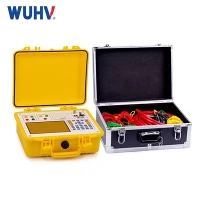


### **High Voltage Tester Applications**
A **high voltage tester** is primarily used to test the dielectric strength and insulation resistance of electrical systems and components by applying high-voltage conditions. This helps ensure the safety, reliability, and proper functioning of electrical systems by identifying weaknesses, such as faulty insulation, which could lead to electrical breakdowns or fires. High voltage testers are used in a variety of industries and applications:
#### **1. Power Generation and Distribution**
* **Application**: High voltage testers are used to test **transformers**, **circuit breakers**, **switchgear**, **bushings**, and **cables** in power plants, substations, and transmission lines.
* **Purpose**: To ensure the electrical insulation of power equipment can handle operational voltage without failure.
#### **2. Cable Testing**
* **Application**: Testing the insulation integrity of electrical cables (e.g., **underground power cables**, **overhead lines**) for both AC and DC applications.
* **Purpose**: Verifying the ability of cables to withstand high-voltage conditions and identifying insulation degradation or breakdown before installation or during maintenance.
#### **3. Electrical Equipment Manufacturing**
* **Application**: Manufacturers of electrical components (e.g., **transformers**, **switchgears**, **motors**, **generators**) use high voltage testers to verify the quality of their products.
* **Purpose**: To test dielectric strength, insulation resistance, and ensure the product meets safety standards before shipment.
#### **4. Electrical System Maintenance and Inspections**
* **Application**: Routine inspections of electrical equipment in industries such as **oil and gas**, **chemical plants**, and **manufacturing facilities** to ensure the integrity of installed electrical systems.
* **Purpose**: To detect potential issues (e.g., insulation deterioration) early to prevent electrical failures or downtime.
#### **5. Testing of High Voltage DC Systems**
* **Application**: In **HVDC (High Voltage Direct Current)** systems used for long-distance transmission, high voltage testers are used for testing **rectifiers**, **inverters**, and **transformers**.
* **Purpose**: To check the insulation resistance and dielectric strength of HVDC equipment to ensure reliability during operation.
#### **6. Testing of Insulation Resistance**
* **Application**: High voltage testers are used to measure the **insulation resistance** of equipment like **motors**, **generators**, **batteries**, and **cables**.
* **Purpose**: Ensuring that insulation remains intact and prevents electrical leakage, which can lead to short circuits, faults, or even fires.
#### **7. Testing for Dielectric Strength in Electrical Materials**
* **Application**: Testing the dielectric strength of materials (e.g., **insulating oil**, **ceramic insulators**) used in high-voltage environments.
* **Purpose**: To verify that the material can withstand high voltage without breaking down.
#### **8. Aerospace and Aviation**
* **Application**: High voltage testers are used in the aerospace industry to test the insulation of **wiring systems**, **circuit boards**, and other electrical components used in **aircraft** and **satellites**.
* **Purpose**: To ensure the equipment remains operational in extreme conditions.
#### **9. Renewable Energy**
* **Application**: Used in testing **wind turbines**, **solar panel inverters**, and **battery storage systems** for the renewable energy industry.
* **Purpose**: To ensure that the electrical components of renewable energy systems are properly insulated and capable of handling high-voltage conditions.
#### **10. Electric Vehicle (EV) and Charging Stations**
* **Application**: Testing of **electric vehicle charging stations**, **electric vehicle batteries**, and **electric drivetrain components**.
* **Purpose**: Verifying insulation resistance and dielectric strength to ensure safe and efficient operation of EV systems.
---
### **Common FAQs about High Voltage Testers**
#### **1. What is a high voltage tester used for?**
* **Answer**: A high voltage tester is used to check the **dielectric strength** and **insulation resistance** of electrical equipment by applying high voltage. It ensures that components like transformers, cables, and motors can operate safely at high voltages without failure.
#### **2. How does a high voltage tester work?**
* **Answer**: A high voltage tester applies a **high-voltage signal** to the electrical component or system under test. The tester measures the **leakage current** or **insulation resistance** to determine whether the insulation can withstand the voltage without breaking down.
#### **3. What is dielectric strength?**
* **Answer**: Dielectric strength refers to the ability of an insulating material to resist electrical breakdown when subjected to a high voltage. High voltage testers measure this strength by applying voltage and observing whether the insulation holds up without failing.
#### **4. What are the common types of high voltage testers?**
* **Answer**: Common types of high voltage testers include:
* **AC High Voltage Testers**: For testing systems that operate on **alternating current (AC)**.
* **DC High Voltage Testers**: For testing systems that operate on **direct current (DC)**.
* **Impulse High Voltage Testers**: For simulating **surge voltages** or **lightning strikes** to test insulation and protection.
* **Insulation Resistance Testers**: These apply DC voltage to check the **resistance** of insulation in cables and equipment.
#### **5. How do I use a high voltage tester safely?**
* **Answer**: When using a high voltage tester, always ensure that:
* Proper **grounding** of the equipment is in place to prevent electric shock.
* The tester is rated for the voltage and current levels you are testing.
* Appropriate **personal protective equipment (PPE)** is worn, such as **insulated gloves**, **safety glasses**, and **rubber boots**.
* Test only when the area is **clear of non-essential personnel** and proper safety protocols are followed.
#### **6. What is the difference between primary and secondary injection testing?**
* **Answer**:
* **Primary Injection Testing**: Involves applying high current directly to the protection relay or equipment under test. This method is used to test the full functionality of the equipment.
* **Secondary Injection Testing**: Involves injecting lower, simulated current into the secondary side of the system or relay, which doesn't require disconnecting the primary circuit.
#### **7. Why is insulation resistance testing important?**
* **Answer**: Insulation resistance testing helps detect faults in the electrical system's insulation, such as **moisture ingress**, **insulation breakdown**, or **wear**. If insulation is faulty, it can lead to **electrical short circuits**, **fires**, or **equipment damage**.
#### **8. What safety measures should I follow when performing high voltage tests?**
* **Answer**: Safety measures include:
* Ensuring the tester is **properly calibrated** and regularly maintained.
* Always **double-check connections** and ensure the system is properly grounded.
* Use **protective equipment** such as rubber gloves, insulated mats, and face shields.
* Follow **safety protocols** and ensure no one is near the test area during operation.
* Test equipment in a **controlled** and **well-marked area**.
#### **9. How do I determine the appropriate voltage for testing?**
* **Answer**: The voltage level should be based on the **rated voltage** of the equipment or system under test. For example, if testing an electrical transformer rated at **13.8 kV**, the high voltage tester should apply a voltage slightly above the **operational voltage rating** (e.g., 1.5 to 2 times the rated voltage) to verify insulation strength.
#### **10. Can high voltage testers be used for equipment other than cables?**
* **Answer**: Yes, high voltage testers can be used to test a wide range of electrical equipment, including:
* **Transformers**
* **Motors**
* **Switchgears**
* **Busbars**
* **Capacitors**
* **Insulation materials**
#### **11. How do high voltage testers measure insulation resistance?**
* **Answer**: High voltage testers apply a high-voltage DC signal to the insulation and measure the resulting current. The **resistance** is calculated by dividing the applied voltage by the leakage current. A high resistance value indicates good insulation, while a low resistance indicates a potential fault or degraded insulation.
#### **12. What is the role of the leakage current in high voltage testing?**
* **Answer**: The **leakage current** is the current that flows through the insulation material when a high voltage is applied. A low leakage current typically indicates good insulation, while a high leakage current suggests that the insulation is **faulty** or **compromised**.
#### **13. What is impulse testing, and why is it important?**
* **Answer**: **Impulse testing** involves applying short, high-voltage pulses to simulate the effects of **surges** (such as **lightning strikes** or **switching transients**) on electrical equipment. It is used to evaluate the equipment's ability to withstand these **temporary high-voltage stressors**.
---
### **Conclusion**
High voltage testers are essential tools for ensuring the **safety** and **reliability** of electrical equipment. They are widely used in the **power generation**, **transmission**, **distribution**, and **manufacturing** industries to verify the **integrity of insulation** and prevent electrical faults. By simulating fault conditions, measuring leakage currents, and assessing dielectric strength,