

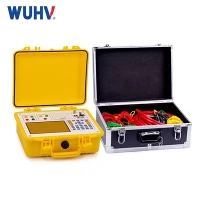


### **1. What is a Load/No-load Tester?**
A **Load/No-load Tester** is an electrical test instrument or setup used to measure the performance characteristics of transformers or motors under **load** and **no-load** conditions. It typically evaluates parameters like losses, efficiency, voltage regulation, and current flow with and without load applied.
* **No-load test:** Measures transformer core losses (iron losses) and magnetizing current without any load connected.
* **Load test:** Measures copper losses and performance under actual operating load.
---
### **2. Purpose**
* **Determine transformer efficiency:** By measuring losses at no-load and full load.
* **Verify voltage regulation:** Check voltage drop under load conditions.
* **Assess machine performance:** Understand losses and heating under operating conditions.
* **Confirm design specifications:** Ensure equipment meets rated performance.
* **Detect faults or abnormalities:** Identify excessive losses or poor regulation indicating issues.
---
### **3. Types of Load/No-load Testers**
* **Transformer Test Sets:** Include devices to apply no-load voltage and load currents, sometimes with built-in load banks.
* **Motor Load Test Equipment:** Dynamometers or electronic loads to apply mechanical or electrical load to motors.
* **Combined Test Systems:** Multifunction testers capable of performing load, no-load, winding resistance, and other tests.
* **Portable Field Load Testers:** Equipment designed for on-site testing under controlled load conditions.
---
### **4. Applications**
* **Power Transformers:** Routine tests during commissioning and maintenance to measure losses and regulation.
* **Distribution Transformers:** Field testing to assess health and efficiency.
* **Electric Motors:** Load testing to verify torque, efficiency, and heating.
* **Generators:** Performance tests under varying load conditions.
* **Industrial Equipment:** Validation of transformers and motors before installation or after repair.
---
### **5. How to Use a Load/No-load Tester**
**No-load Test:**
1. De-energize and isolate transformer/machine.
2. Connect tester to primary winding and apply rated voltage with secondary open.
3. Measure input voltage, current, power (core losses).
4. Record magnetizing current and power factor.
**Load Test:**
1. Connect load (resistive, inductive, or electronic load bank) to secondary winding or machine shaft.
2. Apply rated load current and voltage.
3. Measure input voltage, current, output load, power (copper losses).
4. Calculate efficiency and voltage regulation.
---
### **6. FAQs**
**Q1: Why perform no-load and load tests separately?**
**A:** No-load tests measure core losses, while load tests capture copper losses and performance under working conditions.
---
**Q2: Can load testing damage the equipment?**
**A:** If properly performed within rated limits, no. Overloading can cause damage.
---
**Q3: What safety precautions are needed?**
**A:** Ensure proper isolation, grounding, and load capacity. Follow safety standards.
---
**Q4: How accurate are these tests?**
**A:** Accuracy depends on equipment quality; modern testers provide precise loss and efficiency data.
---
**Q5: Are these tests required by standards?**
**A:** Yes, standards like IEC 60076 specify load and no-load testing for transformers.
---
**Q6: Can load tests be performed on energized transformers?**
**A:** Yes, load tests are done with equipment energized under controlled load conditions.
---
**Q7: What instruments are needed besides the tester?**
**A:** Voltmeters, ammeters, power analyzers, and load banks may be required.