

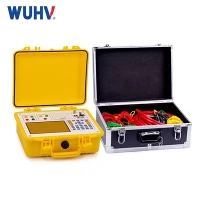


### **1. What is a Winding Resistance Tester?**
A **Winding Resistance Tester** is an electrical test instrument designed to measure the **DC resistance of transformer windings** or other electrical machine windings (motors, generators). It provides precise resistance values that reflect the condition of the winding conductors, connections, and joints.
---
### **2. Purpose**
* **Detect winding faults:** Identify open circuits, shorted turns, or poor connections.
* **Assess winding condition:** Changes in resistance over time can indicate overheating or aging.
* **Quality control:** Verify winding resistance during manufacturing or repair.
* **Confirm repair quality:** Ensure that rewinding or jointing work is correctly performed.
* **Prevent failures:** Early detection helps avoid transformer or motor breakdowns.
---
### **3. Types of Winding Resistance Testers**
* **Micro-Ohmmeters:** Measure very low resistances (micro-ohms to milliohms) with high accuracy.
* **Digital Winding Resistance Testers:** Provide digital readings, data storage, and analysis.
* **Portable Field Testers:** Battery-powered, rugged, suitable for on-site testing.
* **Bench-Top Testers:** Laboratory-grade instruments with higher precision and advanced functions.
* **Automatic Testers:** Perform multiple winding resistance tests and automatically record results.
---
### **4. Applications**
* **Power Transformers:** Measure winding resistance during manufacturing, commissioning, maintenance, and repair.
* **Electric Motors & Generators:** Diagnose winding integrity and connection issues.
* **Switchgear & Reactors:** Verify winding resistances in inductors and other components.
* **Railway & Traction Equipment:** Test traction motors and transformers.
* **Industrial Equipment:** Routine maintenance of rotating machines.
---
### **5. How to Use a Winding Resistance Tester**
1. **Preparation**
* Ensure equipment is de-energized, isolated, and discharged.
* Identify and clean connection points for good contact.
2. **Connection**
* Connect test leads to the winding terminals according to the instrument manual.
* Use four-wire (Kelvin) method leads if available for higher accuracy.
3. **Set Test Parameters**
* Select appropriate test current and range.
* Input winding details if required.
4. **Perform Test**
* Apply DC current and measure voltage drop to calculate resistance.
* Repeat tests if necessary for different windings or tap positions.
5. **Analyze Results**
* Compare measured resistance with baseline or manufacturer values.
* Look for deviations indicating faults or deterioration.
6. **Document**
* Save, print, or export test data for record-keeping.
---
### **6. FAQs**
**Q1: Why measure winding resistance?**
**A:** It indicates winding health, detects faults, and verifies repairs, essential for reliability.
---
**Q2: How accurate are winding resistance testers?**
**A:** High-quality testers measure resistances down to micro-ohms with precision better than ±0.1%.
---
**Q3: Can winding resistance testing damage equipment?**
**A:** No, tests use low DC currents designed to be safe and non-destructive.
---
**Q4: Why use a four-wire (Kelvin) measurement?**
**A:** It eliminates lead and contact resistance for precise low-resistance measurements.
---
**Q5: When should winding resistance tests be performed?**
**A:** During manufacturing, commissioning, after repairs, and regularly in maintenance schedules.
---
**Q6: Can this test detect insulation problems?**
**A:** No, it tests conductor continuity and connections, not insulation.
---
**Q7: What test current is typical?**
**A:** Currents range from a few amps to tens of amps depending on winding size and tester capacity.
---
**Q8: What standards govern winding resistance testing?**
**A:** IEC 60076-1, IEEE C57.12.90, and IEC 61378 provide guidelines.