

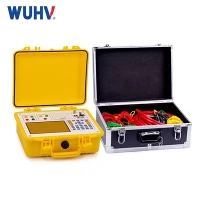


### **1. What is a Tan Delta Test Set?**
A **Tan Delta Test Set** (also called a **Dissipation Factor Tester**) is an electrical test instrument used to measure the **dissipation factor (tan δ)** and **capacitance** of insulation materials in electrical equipment. The tan delta value indicates the **dielectric losses** within the insulation and is a key parameter to assess the insulation's condition, moisture content, aging, and contamination.
---
### **2. Purpose**
* **Assess insulation quality and health** in transformers, cables, bushings, capacitors, and switchgear.
* **Detect insulation deterioration**, moisture ingress, or contamination before failures occur.
* **Perform condition-based maintenance** to extend equipment life and avoid unscheduled outages.
* **Verify manufacturing quality** during production and acceptance testing.
* **Monitor insulation aging over time** through periodic testing.
---
### **3. Types of Tan Delta Test Sets**
* **Portable Handheld Testers:** Lightweight, battery-powered for field use, suitable for quick diagnostics.
* **Bench-top/ Laboratory Testers:** Higher precision and capable of testing large power equipment with higher voltage ratings.
* **Automatic Digital Testers:** Fully automated with advanced data logging, analysis, and reporting functions.
* **Multi-function Testers:** Combine tan delta testing with other insulation tests such as insulation resistance (megger) or partial discharge measurement.
---
### **4. Applications**
* **Power Transformers:** Monitor insulation condition of windings and bushings.
* **Power Cables:** Detect insulation deterioration and moisture presence.
* **Switchgear and Circuit Breakers:** Assess insulation health and aging.
* **Capacitors and Reactors:** Measure dielectric losses for quality control and maintenance.
* **Insulating Materials:** Evaluate new materials during R\&D and manufacturing.
---
### **5. How to Use a Tan Delta Test Set**
1. **Preparation**
* Ensure the equipment under test (EUT) is de-energized and isolated.
* Clean test connections and ensure good contact.
* Verify grounding and safety clearances.
2. **Setup**
* Connect the test leads according to the instrument's manual.
* Input necessary parameters such as rated voltage and frequency of the equipment.
3. **Perform the Test**
* Apply the test voltage gradually up to the specified level (usually rated voltage).
* Measure tan delta and capacitance values, often at power frequency (50/60 Hz).
* Some instruments perform automatic voltage stepping and measurement.
4. **Data Recording & Analysis**
* Save measurement data and compare with baseline or standard values.
* Interpret results: higher tan delta indicates increased insulation losses or deterioration.
5. **Reporting**
* Generate detailed reports with graphs and measurement data for documentation.
---
### **6. FAQs**
**Q1: What is tan delta and why is it important?**
**A:** Tan delta (tan δ) is the ratio of resistive (loss) current to capacitive (charging) current in insulation. It indicates dielectric losses, where higher values often mean insulation degradation.
---
**Q2: What typical tan delta values indicate good insulation?**
**A:** Generally, values below 0.5% (0.005) at rated voltage and frequency indicate good insulation, but acceptable limits vary by equipment type and standards.
---
**Q3: Can tan delta testing detect moisture in insulation?**
**A:** Yes, moisture increases dielectric losses, causing tan delta values to rise.
---
**Q4: How does tan delta testing differ from insulation resistance testing?**
**A:** Insulation resistance measures DC resistance, while tan delta measures AC dielectric losses, providing more sensitive detection of insulation quality.
---
**Q5: Can tan delta tests be performed on energized equipment?**
**A:** No, tests must be done on de-energized equipment for safety and accuracy.
---
**Q6: Which standards govern tan delta testing?**
**A:**
* IEC 60034-27-2 (rotating machines)
* IEC 60422 (transformers)
* IEEE Std 95 (transformers)
* IEC 60270 (partial discharge, often performed alongside tan delta)
---
**Q7: How often should tan delta tests be conducted?**
**A:** Typically during commissioning, post-repair, and periodically every 1-3 years or as recommended by maintenance programs.
---
**Q8: What factors can affect tan delta test results?**
**A:** Temperature, humidity, test voltage, frequency, connection quality, and equipment condition.