

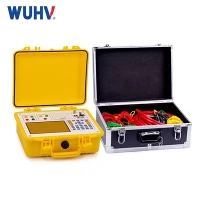


1. What is a BDV Tester?
A Breakdown Voltage Tester (BDV Tester) is an instrument used to measure the dielectric strength of insulating oil, such as transformer oil. It determines the voltage at which the oil fails electrically, indicating its insulation quality.
2. Why is BDV testing important?
Detects moisture, contaminants, and degradation in transformer oil
Helps prevent electrical breakdown, arcing, and insulation failure
Ensures safe operation of transformers and oil-filled switchgear
Supports preventive maintenance and condition monitoring
3. How does a BDV test work?
Oil is poured into a test cell with standard gap electrodes (usually 2.5 mm or 4 mm apart)
Voltage is increased gradually at a fixed rate (usually 2 kV/sec)
The voltage at which the oil breaks down (sparks or arcs across the electrodes) is recorded
The test is repeated several times and an average value is taken
4. What is a typical BDV value for good transformer oil?
| Oil Condition | Typical BDV Value |
|---|---|
| New oil | > 60 kV |
| Good oil | > 50 kV |
| Marginal | 30–50 kV |
| Poor/contaminated | < 30 kV |
Values depend on oil type, standards, and transformer voltage class.
5. Which standards govern BDV testing?
IEC 60156 – Electric strength of insulating oil
ASTM D877 / D1816 – Dielectric breakdown voltage
IS 6792 – Indian standard for insulating oil
6. What is the electrode configuration in the test cell?
Spherical or mushroom-shaped electrodes
2.5 mm or 4 mm electrode gap
Material: usually brass, stainless steel, or chrome-plated copper
Clean and smooth surface is essential for accurate testing
7. What are the types of BDV Testers?
| Type | Description |
|---|---|
| Manual | Operator adjusts voltage manually and observes breakdown visually |
| Semi-automatic | Motorized voltage control, operator stops at breakdown |
| Fully automatic | Automatic voltage ramping, detection, result calculation, and safety interlocks |
8. What features do modern BDV testers include?
Digital display and touch interface
Programmable test sequences (1 to 6 breakdowns)
Automatic oil stirring and temperature monitoring
Built-in printer and USB data export
Over-voltage and safety protection
9. Can BDV testers be used on-site?
Yes. Many models are portable, robust, and designed for field testing of transformer oil on-site.
10. What are causes of low BDV results?
| Cause | Impact |
|---|---|
| Moisture | Lowers dielectric strength significantly |
| Dirt/impurities | Causes early arcing |
| Aging oil | Degraded molecules reduce insulation |
| Poor sampling | Contamination during sample collection |
11. How to ensure accurate BDV testing?
Use clean and dry test cells
Follow proper oil sampling procedure
Maintain standard electrode gap
Avoid air bubbles in the oil
Use fresh, uncontaminated oil
12. How often should transformer oil be tested for BDV?
Annually during routine maintenance
After oil filtering/refilling
When insulation failure or degradation is suspected
13. Who are the leading manufacturers of BDV Testers?
If you are looking for Transformer Oil BDV Tester manufacturers and suppliers, please feel free to contact us for high quality and good price, we have various types of tester for sales to solve your problems.
Our company has been specializing in the production and manufacturing of frequency series resonance devices for 21 years. We operate a modern intelligent factory covering over 4000 square meters, equipped with more than 100 automated production, manufacturing, assembly, and testing machines. We have obtained CE certification and currently serve the over the word customers .
14. What safety features should a BDV tester include?
Oil chamber safety enclosure
Automatic shutoff on breakdown
Interlock switches
Over-voltage and over-current protection
15. Is BDV testing sufficient for oil condition assessment?
Not completely. It should be combined with other tests such as:
Moisture content (ppm)
Acidity/Neutralization number
Interfacial tension (IFT)
Dissolved Gas Analysis (DGA)
Color and appearance