

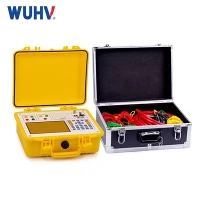


### **1. What is an SFRA Test Kit?**
An **SFRA (Sweep Frequency Response Analysis) Test Kit** is a specialized diagnostic instrument used to assess the **mechanical integrity and winding condition of power transformers** by analyzing their frequency response. The test involves applying a range of frequencies to transformer windings and measuring the resulting response to detect deformation, displacement, or damage of internal components.
---
### **2. Purpose**
* **Detect mechanical faults:** Identify winding deformation, core movement, shorted turns, and loose clamping caused by transportation, faults, or aging.
* **Prevent catastrophic failures:** Early detection allows timely maintenance or replacement.
* **Verify transformer condition post-transport or repair:** Ensure no damage during handling.
* **Complement electrical insulation tests:** SFRA detects mechanical issues that other tests may miss.
* **Support asset management:** Track condition changes over transformer lifetime.
---
### **3. Types of SFRA Test Kits**
* **Portable Handheld SFRA Kits:** Lightweight, field-usable units with battery power for on-site testing.
* **Bench-top SFRA Analyzers:** Laboratory-grade instruments with higher precision and extensive frequency ranges.
* **Integrated Multifunction Testers:** SFRA modules incorporated into advanced transformer test sets.
* **Software-based SFRA Tools:** Require external signal generators and analyzers, controlled via PC software.
---
### **4. Applications**
* **Power Transformers:** Most common application to assess winding and core mechanical integrity.
* **Instrument Transformers:** Detect mechanical stress in CTs and PTs.
* **Reactors and Autotransformers:** Check winding displacement or core issues.
* **On-site Maintenance and Factory Testing:** Verify new, repaired, or transported transformers.
* **Condition Monitoring Programs:** Periodic testing to identify progressive deterioration.
---
### **5. How to Use an SFRA Test Kit**
1. **Preparation**
* Ensure transformer is de-energized, isolated, and properly grounded.
* Identify test points on primary and secondary windings based on transformer wiring diagrams.
2. **Connection**
* Connect SFRA test leads to the specified transformer winding terminals.
* Ensure good contact and minimize external interference.
3. **Test Configuration**
* Set frequency sweep range (typical 10 Hz to 2 MHz).
* Select winding and test mode as required.
4. **Perform Frequency Sweep**
* The SFRA kit injects a swept frequency signal into the winding and measures the output response.
* The instrument records amplitude and phase response across the frequency range.
5. **Data Analysis**
* Compare test curves against baseline data from factory tests or previous measurements.
* Look for deviations, notches, or shifts indicating mechanical or electrical faults.
6. **Reporting**
* Save data and generate detailed reports with graphical frequency response plots.
---
### **6. FAQs**
**Q1: What kind of faults can SFRA detect?**
**A:** SFRA can detect winding deformation, core movement, shorted turns, open circuits, loose clamping, and tap changer issues.
---
**Q2: Can SFRA testing damage the transformer?**
**A:** No, SFRA uses low-level test signals that are safe and non-destructive.
---
**Q3: How often should SFRA testing be done?**
**A:** Recommended during commissioning, post-transport or repair, and periodically (e.g., every 3-5 years) for condition monitoring.
---
**Q4: What are baseline measurements?**
**A:** Baselines are reference SFRA signatures taken when the transformer is known to be in good condition, used for comparison.
---
**Q5: Is special training required to interpret SFRA results?**
**A:** Yes, interpretation requires experience and understanding of transformer construction and signal behavior.
---
**Q6: Can SFRA be performed on energized transformers?**
**A:** No, transformers must be de-energized for SFRA testing.
---
**Q7: What standards cover SFRA testing?**
**A:** IEC 60076-18, IEEE C57.149, and CIGRE TB 445 provide guidelines on SFRA methods and interpretation.