

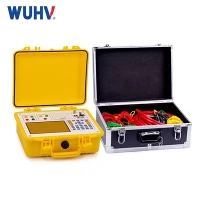


A Wide Voltage Range Battery Charge and Discharge Tester is a multi-functional testing instrument designed to both charge and discharge batteries across a broad voltage range, typically from a few volts up to hundreds or even thousands of volts, depending on the model. It is used to evaluate battery capacity, cycle life, efficiency, health status, and performance under real working conditions.
What Is It?
It's an advanced testing system that:
Charges batteries using precise, programmable parameters
Discharges batteries with controlled load profiles
Measures key battery parameters: capacity (Ah/Wh), internal resistance, charge/discharge efficiency, cycle performance
Supports testing over a wide voltage range (e.g. 10V–1000V), enabling it to test individual batteries, battery modules, or full battery packs
What Is It Used For?
| Application | Purpose |
|---|---|
| 🔋 Battery R&D | Characterize new battery chemistries and technologies |
| 🏭 Factory Testing | Pre-delivery charge/discharge and quality inspection |
| 🔁 Cycle Life Testing | Repeated charging/discharging to evaluate longevity |
| 🧰 Maintenance | Diagnose batteries in UPS, telecom, solar, or EV systems |
| ⚡ Energy Storage Testing | Check lithium, lead-acid, LiFePO4, NiMH, etc. in ESS or hybrid systems |
Main Functions
1. Charging Test
Constant Current (CC), Constant Voltage (CV), or CC–CV mode
Program exact voltage and current settings
Check charging efficiency and voltage rise profile
2. Discharge Test
Constant Current (CC), Constant Power (CP), Constant Resistance (CR)
Measures discharge capacity (Ah/Wh) and voltage drop
Stops based on time, voltage, capacity, or temperature
3. Cycle Testing
Automatically performs charge–discharge cycles to measure:
Cycle life (number of cycles before capacity falls below a set level)
Degradation behavior
Round-trip energy efficiency
4. Data Acquisition & Analysis
Real-time recording of:
Voltage (V)
Current (A)
Temperature (°C)
Power (W)
Time (s)
Capacity (Ah/Wh)
Generates automatic test reports and graphs
Typical Specifications
| Parameter | Range |
|---|---|
| Voltage range | 10V–500V / 800V / 1000V+ |
| Current | 1A – 1000A or more |
| Power | Up to 300kW+ (with external load banks) |
| Modes | CC, CV, CP, CR, dynamic profile |
| Cut-off limits | Voltage, current, capacity, time, temperature |
| Accuracy | Voltage: ±0.1%; Current: ±0.2% typical |
Battery Types Supported
Lithium-ion (Li-ion, NMC, LFP, LTO)
Lead-acid (VRLA, AGM, GEL)
Nickel-based (NiMH, NiCd)
Flow batteries
Sodium-ion
Battery packs and modules
Example Use Cases
EV Battery Pack Testing – for automotive R&D and BMS validation
UPS System Maintenance – test backup batteries under real loads
Energy Storage System (ESS) Testing – for solar or hybrid applications
Battery Aging Analysis – in labs or production quality control
Field or Lab-based Performance Testing
Common Features
| Feature | Description |
|---|---|
| 🔌 Bi-directional Power Flow | Can charge and discharge using same ports |
| 🧠 Programmable Profiles | Set custom charge/discharge steps or import drive cycles (like WLTC, HPPC) |
| 🌐 PC Software or Touchscreen UI | For control, graphing, and logging |
| ⚠️ Safety Protection | Overvoltage, overcurrent, overtemp, reverse polarity |
| 🧾 Report Generation | PDF/CSV/Excel test results with curve plots |
Standards Supported
IEC 62660-1/2 (for lithium batteries in EVs)
IEC 61960 (portable lithium cells)
IEEE 1188, IEEE 1106 (lead-acid battery testing)
UL 2054, SAE J2464 (safety and abuse testing)
Advantages of Wide Voltage Range Charge–Discharge Testers
One system can test small cells to full battery packs
Enables automated cycling and aging studies
Reduces cost by combining charge/discharge in one device
Ideal for R&D, quality control, and field diagnostics