


Product introduction
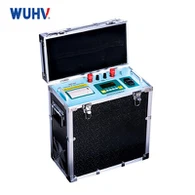
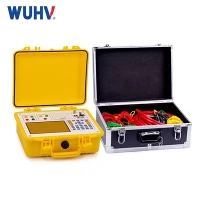
PD Detector is an indispensable high-tech diagnostic tool in modern power equipment status monitoring and preventive maintenance. It captures various physical signals generated by partial discharge (electromagnetic waves, sound waves, transient voltage, pulse current) to achieve early, non-destructive, live detection, localization, and evaluation of internal insulation defects in equipment.


Product Parameters
TEV measurement
| Measuring range | 0dB-60 dB |
| Resolution | 0.1dB |
| Precision | ±1dB |
| Maximum pulse per cycle | 1400 |
| Measurement frequency band | 3~100MHz |
AE measurement
| Measuring range | 0dB~60dB |
| Resolution | 0.1dB |
| Frequency Range | ±1dB |
| Frequency Range | 20~200 kHz |
AA,AA1,AA2 measurement
| Measuring range | 0dB~60dB |
| Resolution | 0.1dB |
| Precision | ±1dB |
| Sensor center frequency | 40kHz |
UHF measurement
| Detection frequency | 300-2000MHz |
| Measuring range | 0-60 dBV |
| Sensitivity | <1dBm |
| Sensor frequency band | 300-2000MHz |
HFCT measurement
| Sensor transmission impedance | 5mV/mA |
| Detection frequency | 1~30MHz |
| Resolution | 0.1dB |
| Sensitivity | ≤50pC |
Hardware
| Shell | ABS |
| Screen | 4.3 inch RGB LCD screen, resolution 800*480 |
| Sampling accuracy | 12bit |
| Synchronization mode | Internal synchronization |
| Connector | USB interface (also charger input) |
| 3.5mm stereo headphone jack | |
| External sensor input interface | |
| Earphone | 8 Ω minimum |
| SD card | Standard configuration 16G ~ 64G |
| Built-in battery | 3.7V/10000mAh lithium battery |
| Operating hours | Approxi. 12 hours |
| Charger | DC 5V/3A |
| Operating temperature | -20 ~ 50℃ |
| Humidity | 20-85% relative humidity |
| Volume and weight | 210*100*35(mm) 0.4KG(host) |


Functional Features of PD Detector
Portability: Designed to be lightweight and easy to carry to different on-site locations for testing.
Multi-method integration: Modern high-end inspection instruments typically support multiple detection methods such as UHF, US, TEV, HFCT, etc., to adapt to different equipment and testing requirements.
High sensitivity: Capable of detecting weak partial discharge signals.
Anti-interference capability: Equipped with strong digital signal processing functions (such as filtering, FFT, phase analysis, pulse recognition algorithms, etc.), enabling effective extraction of PD signals from complex on-site noise.
Positioning function: Combines UHF time-difference positioning, ultrasonic (US) acoustic-electric joint positioning, and US amplitude comparison positioning technologies to help determine the location of the discharge source.
Diagnosis and evaluation: Provides discharge intensity (e.g., dB µV, dBm, mV, pC - subject to calibration), phase-resolved partial discharge (PRPD) patterns, pulse sequence maps, and discharge trend charts. These help identify discharge types (internal discharge, surface discharge, corona discharge, etc.) and assess severity.
Data storage and analysis: Records detection data, location information, environmental parameters, etc., and supports transfer to a computer for in-depth analysis, report generation, and historical trend tracking.
Display and human–machine interaction: Equipped with a large LCD screen that intuitively displays measurement results, spectra, and parameters; the user interface is user-friendly.
Battery-powered operation: Supports long-duration field work.
Wireless connectivity: Some models support Bluetooth or Wi-Fi for convenient data transmission and remote control.
Typical application scenarios 0f PD Detector
Substation: Transformer GIS, Circuit breakers, current/voltage transformers, lightning arresters, busbars, insulators, etc.
Distribution room: medium voltage switchgear (ring main unit, inflatable cabinet, etc.), distribution transformers.
Transmission lines: cable terminations, intermediate joints, overhead line insulators, fittings.
Power plant: generator, exciter, large electric motor.
Industrial users: High voltage electrical equipment in the factory.
Equipment manufacturer: Factory testing, type testing.
Equipment installation and debugging: Pre operation testing.
FAQS
1. What methods are supported in UHV PD testing systems?
UHV PD testing typically uses a multi-physics detection architecture with multi-sensor coordination and multi-channel synchronous analysis:
UHF (Ultra High Frequency) - the primary method for GIS systems
HFCT (High-Frequency Current Transformer) - for cables and grounding circuits
TEV (Transient Earth Voltage) - for switchgear detection
Ultrasonic / AE (Acoustic Emission) - for locating airborne and surface discharges
2. Which power equipment is covered by UHV PD systems?
UHV-grade PD detection systems are generally applied to:
UHV GIS systems (110kV–1000kV GIS)
Extra-high-voltage XLPE transmission cables
Main power transformers (UHV-class large transformers)
High-voltage substations / GIS switchgear assemblies
Reactors and capacitor banks
3. What sensitivity is required for UHV PD detection?
Typical requirements include:
pC-level sensitivity (IEC 60270 equivalent charge)
μV / mV-level weak signal detection capability
UHF detection sensitivity down to around −60 dBm or lower
Stable high SNR (signal-to-noise ratio) output
4. How is strong electromagnetic interference handled on site?
Common interference sources include:
GIS switching transients
High-frequency electromagnetic noise
Ground loop noise
Harmonics from power electronic devices
UHV PD systems typically rely on:
FFT spectral analysis
Adaptive digital filtering
PRPD (Phase-Resolved Partial Discharge patterns)
Pulse pattern recognition algorithms
Multi-channel synchronous noise suppression
5. Does the PD Detector support PD localization?
UHV-level positioning methods include:
UHF Time Difference of Arrival (TDOA)
Dual-sensor ultrasonic differential positioning
Amplitude comparison method
Multi-point GIS inversion algorithms
6. Can PD types be identified?
UHV PD detectors are capable of identifying:
Internal discharge
Surface discharge
Corona discharge
Output analysis typically includes:
PRPD (Phase-Resolved Partial Discharge) patterns
PRPS 3D phase-resolved maps
Discharge trend curves (trend analysis)
7. Does the PD Detector support data management and reporting?
UHV systems generally support:
Multi-project data management (substation / asset-based)
Automatic IEC-style test report generation
Export in PDF / Excel / SCADA formats
Historical trend comparison (condition monitoring)
Cloud or local database storage
8. Does the software meet UHV application requirements?
UHV software platforms typically include:
PRPD automatic recognition algorithms
Multi-channel synchronous correlation analysis
GIS compartment-level analysis models
Noise identification and suppression models
Expert diagnostic systems (AI-assisted analysis)
9. Is the PD Detector suitable for on-site substation testing?
UHV systems are designed with:
Portable or modular structure
Battery operation ≥ 8–12 hours
Single-person operation capability
Strong EMI-resistant design
Support for elevated GIS compartment testing
10. Does PD Detector support wireless and remote expert diagnostics?
Modern UHV PD systems support:
Wi-Fi / Bluetooth connectivity
Real-time data transmission
Remote expert diagnosis
Synchronized App / PC control
11. Does PD Detector comply with international standards?
Relevant standards include:
IEC 60270 (Partial discharge measurement)
IEC 62478 (UHF PD detection methods)
IEC 60071 (Insulation coordination)
IEEE C57 series (transformer-related standards)
12. Does PD Detector support FAT/SAT testing?
UHV systems support:
Factory Acceptance Test (FAT)
Site Acceptance Test (SAT)
Commissioning tests
Condition-based preventive maintenance
13. How is calibration and traceability ensured?
UHV systems provide:
Factory calibration certificates
Traceability to national/international metrology standards
Periodic recalibration support
Software-based automatic compensation and correction
We are a professional PD detector manufacturers in China.We can provide the best professional PD detector for sales and competitive price. If you are looking for PD detector supplier, we are a good choice.
Contact us to get PD detector price.
Hot Tags: pd detector, China pd detector manufacturers, suppliers, factory