



Product introduction
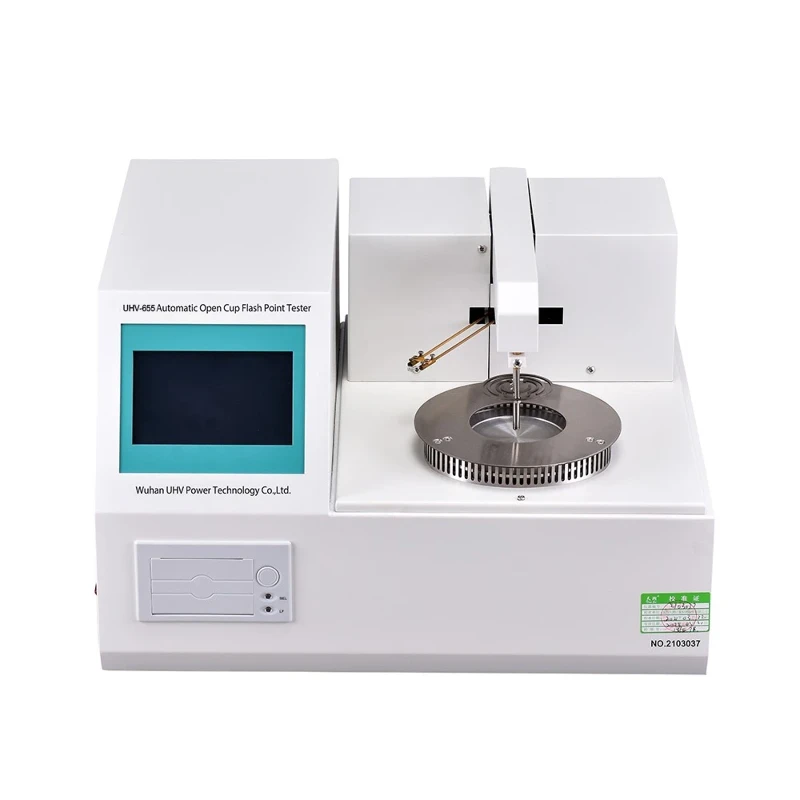
The Open Cup Flash Point Measuring Instrument is a standard equipment for flash point testing in modern laboratories. automatic open cup flash point tester factory provides efficient, accurate, reproducible, and internationally standardized flash point test results through highly automated heating, stirring, ignition, detection, and judgment processes, while ensuring the safety of operators. Plays a crucial role in safety assessment and quality control in fields such as petrochemicals, quality inspection, electricity, and scientific research. Its core value lies in enhancing security, ensuring data reliability, and improving testing efficiency.

Product Characteristics
1. Strong functionality. It can be used for both flash point and ignition point detection, and print test results. It has a clock chip inside, which automatically displays the current date, time, and power failure retention.
2. High precision. The temperature error is controlled within ± 1.5 ℃, with a resolution of 0.1℃.
3. Good repeatability. Under the premise of ensuring that the testing environment complies with GB3536 (ASTM D92) or GB/T 267-88, continuously test the same sample,and the difference in flash point values between the two is ≤4℃.
4. High degree of automation. automatic open cup flash point tester supplier can automatically complete the testing process, perform cooling, and provide automatic information prompts.
Product functions
1. Flash point determination function: Used for determining the open-cup flash point of petroleum products, lubricating oils, transformer oils, and other applicable combustible liquids.
2. Fire point determination function: Can be used to determine the fire point of test samples, providing reference for evaluating the combustion characteristics and safety performance of oil products.
3. Automatic heating function: Heats the test sample according to the set test conditions and controls temperature changes during the testing process.
4. Automatic stirring function: Stirs the test sample in coordination with the test process, helping to improve the uniformity of temperature distribution in the sample.
5. Automatic ignition function: Performs ignition operations according to the specified test procedure, reducing the impact of manual operation.
6. Flash detection function: Detects whether the sample vapor undergoes instantaneous flash under ignition, to determine the flash point of the sample.
7. Temperature measurement function: Measures and displays the test temperature in real time. The product page specifies a temperature resolution of 0.1°C and a temperature error of ±1.5°C.
8. Automatic testing function: Automatically completes the testing process including heating, stirring, ignition, detection, and result determination, improving testing efficiency.
9. Automatic cooling function: Performs the corresponding cooling process after testing is completed, facilitating subsequent test operations.
Main advantages
High precision and repeatability: eliminates human errors such as ignition time judgment, temperature reading, and heating rate control in manual operation, resulting in more reliable results.
High safety: Operators should stay away from open flames and high-temperature samples. Instruments usually have built-in safety protection (such as over temperature protection, fire extinguishing devices).
High efficiency: Automatic sampling and unmanned testing greatly improve laboratory throughput, especially suitable for batch sample testing.
Compliance with standards: Strictly follow international and national standards (such as ASTM D92, ISO 2592, GB/T 3536, etc.) to ensure the validity and comparability of test results.
Data traceability: Automatically record and store test data and process parameters for easy auditing and quality control.
Easy to operate: reduces the skill requirements and training costs for operators. Just put in the sample (or sample cup), set the parameters, and start the test.
Reduce solvent exposure: Automated operations reduce the opportunity for operators to come into contact with harmful solvent vapors.
Main application areas
Petroleum refining and sales: quality control and safety indicators for products such as gasoline, diesel, kerosene, fuel oil, crude oil, asphalt, etc.
Chemical industry: various solvents (paint thinners, cleaning agents), chemical raw materials, resins, plasticizers, etc.
Lubricating oil industry: Determine the flash point of base oil and finished lubricating oil.
Power industry: monitoring of insulation and lubricating oils such as transformer oil and turbine oil.
Quality inspection agencies and third-party laboratories: conduct product compliance testing and safety assessments.
Research and Development: Safety Assessment of New Materials, Formulas, or Processes.
Transportation and storage of dangerous goods: Flash point is an important basis for the classification of dangerous goods (flammable liquids).
FAQs
1. What is an Automatic Open Cup Flash Point Tester used for?
It is used to determine the flash point and fire point of petroleum products, lubricants, bitumen, and other flammable liquids using the Open Cup method. The flash point is the lowest temperature at which vapors ignite, helping assess fire hazards for storage and transportation.
2. What is the difference between open cup and closed cup methods?
The open cup method exposes the liquid surface to air, simulating conditions where vapors can disperse freely. It is used for heavier oils and lubricants with flash points above 79°C. The closed cup method traps vapors above the liquid and is used for lower-flash-point fuels and solvents.
3.What is the working principle of an open cup flash point tester?
The instrument heats a sample in an open test cup under specified conditions. An ignition source is applied at prescribed intervals or temperatures to determine the temperature at which the sample vapor produces a momentary flash.
4.What is the difference between an open cup and a closed cup flash point tester?
An open cup tester measures flash point with the sample exposed to the surrounding atmosphere, while a closed cup tester uses a covered test chamber. Results may differ because of variations in vapor retention and test conditions.
5. What are the after-sales terms?
The automatic open cup flash point tester manufacturer provides free consultation services, a one-year warranty, and uses various methods such as email communication, video calls, and technical on-site visits to promptly solve any after-sales problems.
We specialize in oil testing equipment, providing the UHV-655 Open Cup Flash Point Tester for transformer oil testing, petroleum analysis, and laboratory quality control. Contact us today to get the latest UHV-655 flash point tester price, detailed technical specifications, and a competitive quotation. We are committed to providing reliable testing solutions, professional technical support, and efficient service to customers worldwide.
Hot Tags: open cup flash point measuring instrument, China open cup flash point measuring instrument manufacturers, suppliers, factory, Transformer insulating oil BDV measurement tool, dga test of transformer oil, Fast test system for transformer oil, dissolved gas in transformer oil analysis, Transformer oil quality control test kit, Oil insulation resistance test kit


