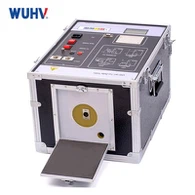

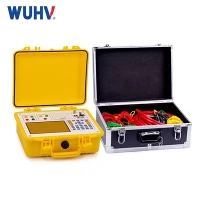


Transformer Capacity and No-Load Loss Tester
The Transformer Capacity and No-Load Loss Tester is an integrated testing solution engineered to accurately measure transformer capacity, no-load loss, no-load current, and other critical electrical characteristics during production inspection, commissioning, and preventive maintenance.
Key Testing Capabilities
Transformer Capacity Measurement Directly verifies actual transformer capacity against nameplate ratings, design specs, or historical records to identify underrated or mislabeled assets during acceptance audits.
No-Load Loss & Current Measurement Evaluates core power consumption and excitation characteristics when energized without load, helping technicians detect core degradation and magnetic circuit abnormalities.
Load Loss & Short-Circuit Voltage Testing Measures winding-related electrical parameters under load conditions for a complete assessment of structural integrity and overall health.
Zero-Sequence Impedance Testing Measures asymmetric impedance parameters to ensure compliance with system grounding and protection coordination standards.
Harmonic & Waveform Analysis Captures real-time voltage/current waveforms and harmonic spectrums to identify external power quality issues that could distort measurement accuracy.
Built for Practical Field and Lab Operations
Auto-Range Switching
Automatically selects optimal voltage and current ranges to prevent manual operator errors and accelerate multi-asset testing.
Vector Diagram Verification
Displays real-time 3-phase vectors to check test wiring accuracy before data collection, preventing invalid test runs.
Automated Data Correction
Applies standardized correction algorithms for temperature, voltage, and frequency variations to align raw data with rated baseline conditions.
Target Applications & Users
Transformer Manufacturers: Production-line quality control, routine testing, and pre-shipment compliance verification against IEC/IEEE standards.
Power Utilities & Grid Operators: Commissioning of new installations, periodic maintenance, and sub-station diagnostic health monitoring.
Electrical Testing Contractors: Portable, high-accuracy testing services at remote substations and industrial facilities.
Testing Laboratories & Maintenance Teams: Repeatable precision testing, failure analysis, and post-repair performance verification.
Standard Testing Workflow
Information Verification: Record rated capacity, voltage, current, frequency, and vector group from the asset profile.
Safety Isolation & Grounding: Ensure the transformer is fully de-energized, isolated, and properly grounded according to safety protocols.
Circuit Setup: Connect measurement leads, incorporating external CT/PT units if testing high-voltage assets.
Vector Verification: Review the 3-phase vector display to verify correct wiring and phase alignment.
Test Execution: Select target parameters (Capacity, No-Load Loss, Load Loss, or Harmonics) and run the test routine.
Data Correction & Review: Apply built-in temperature and voltage correction factors to normalize data.
Data Correction & Review: Apply built-in temperature and voltage correction factors to normalize data.
Technical Specifications
|
Parameter |
Technical Specification |
|
Product Type |
Integrated Transformer Capacity & No-Load Loss Tester |
|
Voltage Range |
Direct input up to 750V (Expandable via external PT) |
|
Current Range |
Direct input up to 100A (Expandable via external CT) |
|
Accuracy Class |
Voltage/Current: ±0.2% | Power/Loss: ±0.5% |
|
Applicable Standards |
IEC 60076, IEEE C57.12, ANSI |
|
Display Capabilities |
Real-time 3-Phase Vector Diagram & Harmonic Waveform |
|
Data Interface |
Internal Memory, USB Export, RS232 / RS485 |
Technical Information Required for Quotes
To help our application engineers recommend the right configuration for your testing needs, please prepare the following details before requesting a quote:
- Transformer Capacity Range (kVA / MVA)
- Primary and Secondary Voltage Ratings (kV)
- Transformer Configuration (Single-Phase or Three-Phase)
- Primary Application Environment (Factory QC or Substation Field Maintenance)
- Applicable Standards (IEC, IEEE, ANSI, or Local Standards)
FAQ
Q: What is a Transformer Capacity and No-Load Loss Tester?
A: It is a test instrument used to measure transformer capacity, no-load current and no-load loss. Depending on the model and configuration, it can also support load loss, short-circuit voltage, zero-sequence impedance, harmonic and waveform measurements.
Q: Why is transformer no-load loss important?
A: No-load loss occurs when a transformer is energized without supplying an external load and is mainly associated with the transformer core. The measured value can be compared with specified values, factory test data or historical records.
Q: Can the tester measure three-phase transformers?
A: Yes. The applicable configuration supports three-phase transformer testing. Three-phase voltage and current information and vector information can help technicians verify the test connection.
Q: Can it be used for field transformer testing?
A: Yes. It can be used for applicable field testing in substations, distribution systems and industrial facilities when the electrical, environmental and safety requirements are satisfied.
Q: Can the tester measure load loss?
A: The applicable configuration can measure load-related characteristics such as load loss and short-circuit voltage. The required range and test method should be confirmed according to the transformer rating.
Q: Why are waveform and harmonic measurements useful?
A: Waveform distortion can affect transformer loss measurements. Harmonic and waveform information provides additional data when investigating unexpected or inconsistent test results.
Q: Can test data be corrected for temperature or non-rated conditions?
A: Applicable correction functions can process measurements for factors such as temperature, test voltage, test current and waveform conditions. The correction method should follow the applicable testing procedure.
Q: What information should I provide when requesting a quotation?
A: Provide the transformer type, capacity, rated voltage, rated current, phase configuration, required test items, intended factory or field application and applicable testing requirements.
Hot Tags: transformer capacity and no-load loss tester, China transformer capacity and no-load loss tester manufacturers, suppliers, factory, High Current Battery Discharge Test Set