

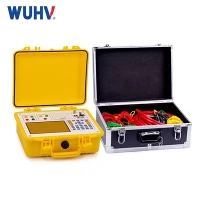


Product introduction
The motor test system is a device specifically used to evaluate the performance of electric motors. It is suitable for measuring key parameters such as output power, efficiency, speed, current, voltage, and temperature rise.
It is commonly used for factory inspection, quality control, and performance optimization during motor development and production processes.
The system can simulate different load conditions and operating environments to evaluate the motor's response and performance under specific operating conditions. It also transmits various operating parameters to the data acquisition module for analysis.
We are a professional Motor Test System manufacturers/Motor Test System suppliers in China.We can provide the best professional Motor Test System for sales and competitive price. Contact us to get Motor Test System price.

Product features

High-precision Measurement Capability
The motor test system has high-precision measurement capabilities and can accurately detect key parameters such as the motor's output power, efficiency, speed, current, voltage and temperature rise, with a measurement accuracy of up to 0.1%. High-precision measurement capabilities help to comprehensively evaluate the performance of the motor and are widely used in factory inspection and quality control of the motor.
Multiple Load Simulation Functions
The test system is equipped with multiple load simulation functions, which can adjust the load of the motor through the load device to simulate the performance of the motor under different working conditions, including power output, energy consumption and efficiency. For example, when testing fan motors, the system can simulate load conditions at different wind speeds to detect the motor's operating efficiency at high and low loads; when testing pump motors, it can simulate different water flow resistances to analyze the motor's performance in actual working conditions. With this flexible load adjustment, manufacturers can ensure the stability of motors under different load conditions before leaving the factory, thereby reducing the risk of field failures and improving product quality.
Real-time Data Analysis
The data acquisition module of the motor test system uses high-speed processors and algorithms to implement data analysis, and can perform trend analysis, rate of change calculation, peak detection, and abnormal fluctuation identification on real-time collected data. For example, when the system detects a sudden increase in temperature or current value, it can immediately mark and generate an alarm so that operators can quickly identify and troubleshoot the problem. Real-time data monitoring and refined analysis help operators to promptly understand the performance of the motor during the test, identify potential problems, and make adjustments.

Product parameters of motor test system
|
Test item |
Measurement range |
Accuracy |
|
|
AC electric test |
Current |
HV: 1A~300A |
0.5 |
|
LV: 1A~1000A |
|||
|
Voltage |
HV: 100~12000Vac |
0.5 |
|
|
LV: 100~700Vac |
|||
|
Frequency |
50Hz |
||
|
DC electric test |
Current |
1A~500A |
0.5 |
|
Voltage |
50~800V DC |
0.5 |
|


What safety protections are included?
Typical protection systems include:
Overcurrent and overvoltage protection
Short-circuit protection
Emergency stop system
Electrical interlocking
Grounding protection
Thermal protection
Can it handle high-power equipment?
Yes. Motor test systems can be configured for:
Small laboratory equipment
Medium industrial motors and transformers
High-power systems with expanded modules
What software functions are provided?
The software typically includes:
Test process control
Real-time monitoring
Curve analysis (efficiency, loss, torque, temperature rise)
Data storage and traceability
Report generation
User permission management
Does motor test system support data traceability?
Yes. It supports:
Serial number tracking
Batch management
Historical performance comparison
Production quality analysis
Can it integrate with MES or ERP systems?
High-end systems support integration with:
MES (Manufacturing Execution Systems)
ERP quality management systems
Smart factory platforms
What standards does motor test system comply with?
Typical standards include:
IEC 60034 (Rotating electrical machines)
IEC 60076 (Power transformers)
IEEE motor and transformer test standards
GB/T national standards
What are key procurement considerations?
Professional buyers focus on:
System stability under continuous operation
Measurement accuracy and repeatability
Level of automation
Load and power capability
Software reliability
Long-term maintenance support
What is the service life of the motor test system?
Overall system: 10–15 years
Load and power modules: 5–10 years maintenance cycle
Sensors and auxiliary components: 3–8 years depending on usage
Is operator training required?
Yes. Operators typically need:
Electrical or electromechanical engineering background
Familiarity with IEC/IEEE testing standards
Basic electrical safety training
What is the future development trend?
Main trends include:
Fully automated production-line testing systems
AI-based performance evaluation and fault prediction
Digital twin modeling of electrical machines
Cloud-based test data management
High-precision integrated testing platforms
What is the core value of this motor test system?
It provides a unified platform for performance verification of motors and transformers, ensuring product quality, improving testing efficiency, and supporting modern industrial manufacturing systems.
Hot Tags: motor test system, China motor test system manufacturers, suppliers, factory, insulation power factor tester, flyback tester, ct pt test, tilt 2 transformer tester, AC DC Motor test bench, electric motor test bench

