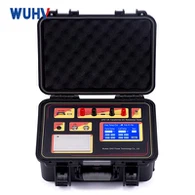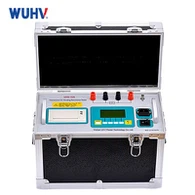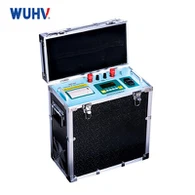

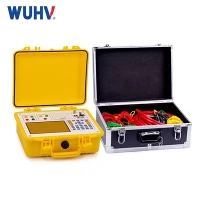


Product introduction
The Winding Resistance Tester is an indispensable and efficient tool in modern electrical testing. Utilizing advanced constant current source technology, high-speed sampling, and intelligent algorithms, it overcomes inductance effects to achieve rapid, precise DC resistance measurements. It incorporates practical functions like demagnetization, anti-interference, and data management. Its core value lies in significantly improving test efficiency, reducing equipment downtime, and enhancing the accuracy and reliability of test data. It provides strong technical support for the safe and stable operation of power systems and the condition assessment of equipment.

Technical parameters of DC winding resistance tester
| Current range and range | 100A | 10μΩ~100mΩ |
| 40A | 50μΩ~500mΩ | |
| 20A | 100μΩ~1Ω | |
| 10A | 500μΩ~2Ω | |
| 5A | 1mΩ~4Ω | |
| Accuracy | ± (0.2%±2 words) | |
| Resolution | 0.1μΩ | |
| Ambient humidity | -10℃~40℃ | |
| Relative humidity | ≤80%RH No condensation | |
| Working power supply | AC220V±10% 50Hz | |
Safety precautions of DC winding resistance tester
1. Power outage and discharge:
The tested device must be completely powered off! This is an absolute prerequisite. Not only should the main power switch be disconnected, but also ensure that all possible power input points are isolated (such as disconnecting the connection between the high and low voltage sides).
Full discharge: Thoroughly discharge the tested equipment (especially large power transformers, capacitors, etc.). Use a dedicated discharge rod and ensure reliable grounding to release residual charges (capacitive and inductive voltages) stored inside the equipment. The discharge time should be sufficient, and a voltage tester should be used to confirm that there is no voltage.
Instrument itself: The output of the tester is DC current. After the test is completed, the tested winding (especially large inductance equipment) will store a large amount of energy, which must be fully discharged through the instrument or an external discharge circuit before the wire can be removed.

2. Reliable grounding:
Grounding of the winding resistance tester: It is necessary to use the grounding terminal or dedicated grounding wire that comes with the instrument, and firmly connect it to a good grounding electrode (such as grounding grid, grounding pile). This is the key to protecting operators and instruments.
Grounding of the tested equipment: Ensure that the casing or iron core of the tested equipment is reliably grounded. This helps to release residual charges and ensure equipotential.
3. High voltage hazard warning:
The output terminal of the tester has voltage during the testing process, and it is forbidden to touch the exposed metal part of the testing clamp.
The dismantling and connection of the test line must be carried out after the instrument has completely stopped outputting and the tested equipment has been fully discharged.
Wear insulated gloves during operation and stand on an insulated pad.
Environment and general maintenance
1. Environmental requirements:
Avoid using winding resistance testers in rainy, snowy, humid, and highly polluted environments (such as conductive dust and corrosive gases). Excessive environmental humidity or surface condensation can significantly increase surface leakage current, affecting measurement accuracy and safety.
Avoid testing near strong electromagnetic interference sources.
The working temperature and humidity should be within the allowable range of the instrument specifications.
2. Instrument maintenance:
Regularly (as recommended by the manufacturer or annually) send winding resistance testers and testing lines to qualified metrology institutions for calibration to ensure measurement accuracy.
Keep the winding resistance testers and testing lines clean and dry. The test line should be neatly coiled and stored to avoid hard bending, squeezing, and heavy object crushing.
When not in use for a long time, remove the battery (if applicable) or store it in a dry environment and charge it regularly (for built-in batteries).


We are a professional winding resistance tester manufacturers in China.We can provide the best professional winding resistance tester for sales and competitive price. If you are looking for winding resistance tester supplier, we are a good choice.
Contact us to get winding resistance tester price.
Hot Tags: winding resistance tester, China winding resistance tester manufacturers, suppliers, factory, 10kV Digital Insulation Tester