

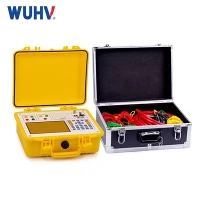


A **Protection Relay Tester** is a specialized device used to test and verify the operation of **protective relays** in electrical systems. Protective relays are critical components that monitor the conditions of electrical circuits and activate protective measures, such as disconnecting power, when faults (e.g., short circuits, overvoltage, or overload) occur. These relays ensure the safety and reliability of power systems by preventing equipment damage, fires, or electrical hazards.
Testing these relays is essential to ensure that they function correctly and respond to faults as intended. Protection relay testers simulate fault conditions and check the relay's response to ensure its proper operation in real-world scenarios.
---
### **Key Functions of a Protection Relay Tester**
1. **Simulate Fault Conditions**:
* A protection relay tester generates various types of **fault signals** (e.g., overcurrent, overvoltage, phase imbalance) and applies them to the protection relay to verify that it operates as expected.
2. **Verify Relay Settings**:
* It helps in **calibrating** and **adjusting** relay settings to ensure that the protection relay's **tripping thresholds** (e.g., current, voltage, time) are correctly configured according to the system requirements.
3. **Check Relay Response**:
* The tester simulates fault conditions and monitors the relay's **reaction time** and whether it **trips** or activates the connected circuit breaker correctly.
4. **Functional Testing**:
* The tester can simulate normal operating conditions and various fault scenarios (e.g., **short circuits**, **ground faults**, **overloads**) to verify that the relay triggers the appropriate protection mechanism (such as **disconnecting the faulty circuit**).
5. **Recording and Analysis**:
* Modern protection relay testers often have the capability to **record** test results, log data, and generate **reports** that can be used for maintenance, troubleshooting, and compliance purposes.
---
### **Key Components of a Protection Relay Tester**
1. **Test Source**:
* This component generates the required signals (e.g., **voltage**, **current**, **frequency**) to simulate faults and operating conditions. The tester should be able to generate both **AC** and **DC** signals depending on the type of relay being tested.
2. **Control Panel**:
* The control panel allows the user to set up test conditions, such as the type of fault (overcurrent, overvoltage, etc.), the **magnitude** of the fault, and the **timing** parameters.
3. **Test Leads and Probes**:
* These are used to connect the protection relay tester to the relay under test. Proper connection is crucial for accurate testing and evaluation.
4. **Measurement and Monitoring Instruments**:
* The tester is equipped with devices for measuring **voltage**, **current**, **frequency**, and other parameters that help assess the relay's response to faults.
5. **Relay Simulation and Control Module**:
* The module helps in simulating relay behavior under fault conditions and monitors the relay's action (whether it trips, whether it resets, etc.).
6. **Data Logging and Reporting**:
* Many modern testers are equipped with software that logs test results, providing a comprehensive view of the relay's performance and allowing for the creation of reports and documentation.
---
### **Types of Protection Relays and Their Testing Requirements**
1. **Overcurrent Relay (OCR)**:
* **Function**: Monitors current levels and trips the breaker if the current exceeds a preset value.
* **Testing**: The tester simulates **overcurrent** conditions by gradually increasing the current until the relay activates. The time delay and current setting can be adjusted and tested.
2. **Differential Relay**:
* **Function**: Detects differences in the current between two or more points in a system, such as the difference between the current entering and exiting a transformer.
* **Testing**: The tester simulates **faults** by creating a differential current condition and checks if the relay correctly trips based on the magnitude of the difference.
3. **Distance Relay (Impedance Relay)**:
* **Function**: Protects transmission lines by measuring the impedance between the source and fault. It trips the breaker when the impedance falls below a preset value, indicating a fault along the line.
* **Testing**: The tester applies **impedance signals** to simulate line faults at different locations and tests the relay's response to varying impedance conditions.
4. **Overvoltage and Undervoltage Relay**:
* **Function**: Monitors the voltage levels and trips the system when the voltage goes above or below the preset thresholds.
* **Testing**: The tester simulates **overvoltage** and **undervoltage** conditions by adjusting the voltage levels and checking the relay's trip and reset behavior.
5. **Ground Fault Relay**:
* **Function**: Detects leakage currents to the ground and provides protection against earth faults.
* **Testing**: The tester generates a **ground fault** and monitors the relay's response to ensure proper trip operation.
6. **Reverse Power Relay**:
* **Function**: Protects generators by detecting when the power flow is reversed, indicating a potential fault.
* **Testing**: The tester simulates **reverse power** conditions and verifies whether the relay trips correctly when the power flow reverses.
---
### **Testing Methods and Procedures for Protection Relays**
1. **Primary Injection Testing**:
* Involves applying a **high current** directly to the protection relay's primary circuit. This test is typically used for verifying the relay's response to high current levels, such as during **overcurrent protection** tests. Primary injection testing requires specialized equipment and safety measures.
2. **Secondary Injection Testing**:
* Involves injecting a **simulated current** (usually much lower than the primary current) into the relay's secondary circuit. It is commonly used for testing **voltage** and **current relays** without requiring disconnection of the primary circuit.
3. **Functional Testing**:
* Verifies that the relay responds appropriately to fault conditions. This can include testing the relay's **trip time**, **reset time**, and **accuracy** in detecting faults, as well as testing the **alarms** and **reset functions**.
4. **Timing and Sensitivity Testing**:
* Involves measuring the **time delay** (also known as **pickup time**) between applying a fault signal and the relay's trip action. This ensures that the relay is responsive to faults and behaves according to preset parameters.
5. **Testing Under Load**:
* Some testing involves subjecting the relay to real-time operational conditions, where the system is loaded and faults are introduced. This allows for verifying the relay's performance during actual system operation.
---
### **Key Considerations When Using a Protection Relay Tester**
1. **Safety Precautions**:
* **High-voltage** testing should always be performed with strict adherence to **safety protocols**. Ensure all connections are secure, and that the tester is rated for the voltage and current levels you are testing.
2. **Relay Settings**:
* Ensure the **test parameters** (voltage, current, time, etc.) match the **relay's settings** before starting the test to avoid incorrect results.
3. **Test Accuracy**:
* Verify that the tester is calibrated regularly to maintain **accuracy** in results and avoid discrepancies in performance evaluation.
4. **Documentation**:
* Use the data logging and reporting features of the relay tester to generate **detailed test reports**. This documentation can be essential for **compliance**, maintenance schedules, and future troubleshooting.
---
### **Conclusion**
A **Protection Relay Tester** is an essential tool for ensuring the **reliability** and **correct operation** of protective relays in electrical power systems. By simulating fault conditions and verifying relay settings and performance, protection relay testers help ensure that relays operate as designed and effectively protect equipment from faults. These testers are crucial for regular maintenance, system validation, and troubleshooting in industrial, commercial, and utility power systems.