

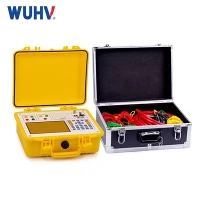


Choosing a VLF AC Hipot Tester requires understanding your specific testing needs, the types of cables or equipment you're testing, applicable standards, and operational conditions. Here's a comprehensive guide to help you choose the right VLF AC Hipot equipment:
1. Define Your Application
| Question | Consideration |
|---|---|
| What voltage level is the cable rated for? | VLF testers must produce test voltages 1.5× to 3× the cable's rated voltage. |
| What type of cable or insulation? | XLPE, EPR, PILC? Some older cables may need more diagnostic testing (e.g., tan δ). |
| Is the test for commissioning, maintenance, or troubleshooting? | For commissioning, a basic VLF Hipot may suffice. For maintenance/troubleshooting, consider models with PD/tan δ options. |
2. Key Selection Parameters
A. Output Voltage
Common output ranges: 20 kV, 30 kV, 40 kV, 60 kV RMS
Choose a unit that provides at least 2× rated phase-to-ground voltage of your system.
Example: For a 15 kV class cable (8.66 kV phase-to-ground), select a tester capable of ≥ 18 kV RMS output.
B. Output Waveform
Sine wave: Required for most standards-compliant withstand and tan δ testing.
Square/trapezoidal wave: Cheaper, but not always acceptable for PD/tan δ.
Ensure your tester meets IEEE 400.2 and IEC 60502 waveform quality requirements.
C. Output Frequency
Most VLF testers operate at 0.1 Hz, some are variable (0.1–0.01 Hz).
Lower frequencies allow testing longer cables without increasing the size of the equipment.
3. Control Features and Safety
| Feature | Description |
|---|---|
| Digital control & display | Allows programmable ramping, timing, and accurate output monitoring |
| Data logging | Essential for traceability and recordkeeping |
| Safety interlock & emergency stop | Mandatory for HV equipment |
| Auto shut-off | Stops test if breakdown is detected |
| Discharge function | Safely discharges cables after testing |
4. Portability & Power Requirements
| Factor | Tip |
|---|---|
| Weight & size | Important for fieldwork or mobile testing |
| Built-in wheels or handles | Helpful for portability |
| Power input | Check if it needs standard 120/230V AC or generator power for field use |
5. Compliance with Standards
Ensure the equipment complies with:
IEEE 400.2 – Field testing of shielded power cable using VLF
IEC 60502-2, CENELEC HD 620 – Medium voltage cable testing
IEEE 400.3 – If doing PD testing
IEEE 400.4 – If using tan delta diagnostics
6. Optional Capabilities to Consider
| Feature | Use |
|---|---|
| Tan Delta (tan δ) testing | For insulation condition assessment |
| Partial Discharge (PD) testing | For locating insulation defects and weak points |
| Time domain reflectometry (TDR) | To pinpoint fault locations (some advanced testers include it) |
| PC software connectivity | For automated reporting and data analysis |
7. Top Brands / Vendors
Wuhan UHV Power Technology Co.,Ltd
https://www.uhvtest.com/high-voltage-tester/vlf-hipot-tester/vlf-ac-hipot-testers.html
8. Budget Consideration
| Capability | Estimated Cost (USD) |
|---|---|
| Basic VLF Hipot (20–40 kV) | $7,000 – $15,000 |
| VLF + Tan Delta | $15,000 – $30,000 |
| VLF + PD + Tan Delta | $30,000 – $60,000+ |
9. Checklist for Selection
| ✅ Check Item |
|---|
| Voltage range matches cable system |
| Sine wave output, compliant with IEEE/IEC standards |
| Portable enough for field conditions |
| Includes safety features |
| Supports withstand testing (at minimum) |
| Optional: Tan δ and PD diagnostics |
| Supports auto ramp/hold/time settings |
| Offers data logging/report generation |
| Backed by warranty and service support |
Final Tips
For utilities or high-traffic industrial systems: Choose models with full diagnostics (PD, tan δ).
For routine field testing/commissioning: A basic, portable VLF Hipot tester may suffice.
Always verify local standards/regulations for HV testing procedures.