

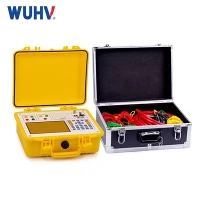


1. What is Primary Current Injection Testing?
Primary Current Injection Testing involves injecting high currents (typically hundreds or thousands of amps) directly into the primary circuit of a device like a CT, breaker, or protection relay. This simulates actual fault conditions to verify the entire protection system's performance.
2. What is the purpose of PCI testing?
Validate protection system operation (relays, breakers)
Confirm CT performance under load
Verify system settings and trip times
Ensure proper coordination among protection devices
3. Which equipment is tested using PCI?
Circuit breakers (especially LV & MV breakers)
Protective relays (overcurrent, differential, etc.)
Current Transformers (CTs)
Switchgear panels
Busbars and feeder protection systems
4. What is the difference between primary and secondary injection testing?
| Feature | Primary Injection | Secondary Injection |
|---|---|---|
| Signal injected | High current into primary path | Signal into relay input terminals |
| Equipment tested | Whole system | Relay only |
| Field realism | Very high | Moderate |
| Complexity and cost | Higher | Lower |
5. What current levels are typically used in PCI?
LV systems: 100A to 10,000A
MV systems: 1,000A to 5,000A
It depends on the device rating and the test being performed.
6. What are the key components of a PCI test set?
Current source / injector: Capable of delivering high current
Control unit: For regulating current and timing
Measurement instruments: For voltage, current, and time
Safety interlocks and protection: Essential for operator safety
7. How is a Primary Current Injection test conducted?
Connect the PCI test set to the primary side of the circuit.
Gradually inject current.
Monitor relay operation and tripping time.
Compare results to expected trip curves or settings.
Record and analyze the data.
8. What parameters are measured in PCI testing?
Injected current magnitude
Relay pick-up and drop-out values
Tripping time
CT ratio and polarity
Breaker response
9. What are the safety precautions for PCI testing?
Use insulated gloves, tools, and PPE
Follow lock-out/tag-out (LOTO) procedures
Use grounded and shielded cables
Never touch connections during testing
Keep non-essential personnel away
10. When should PCI testing be performed?
During commissioning
After protection relay changes
Following breaker maintenance
As part of routine preventive maintenance
11. What standards guide PCI testing?
IEC 61850 – Communication in substation automation
IEEE C37.90 – Relays and protection systems
IEC 60255 – Measuring relays and protection equipment
Manufacturer-specific standards and test protocols
12. What are the limitations of PCI testing?
Requires equipment shutdown
Can be time-consuming and resource-intensive
Equipment must be rated for test current
High risk if not properly handled
If you are looking for Primary Current Injection Testing manufacturers and suppliers, please feel free to contact us for high quality and googl price of the Primary Current Injection Testing and a more detailed introduction. Wuhan UHV is an expert of Primary Current Injection Testing in Electrical field. As an Factory of Primary Current Injection Testing, it integrats design, development, manufacturing and marketing in China, Wuhan UHV has various types of Primary Current Injection Testing for sales to solve your problems.