

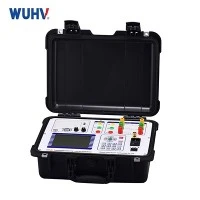


1. What is a Relay Protection Tester?
A Relay Protection Tester is an advanced instrument used to simulate electrical faults and test the performance, accuracy, and response time of protection relays in power systems. It ensures that relays operate correctly under real-world fault conditions to protect transformers, feeders, motors, and generators.
2. What are the main functions of a relay protection tester?
Inject precise AC/DC voltages and currents
Simulate faults (overcurrent, undervoltage, differential, distance, etc.)
Measure trip time and pickup/dropout thresholds
Test relay logic and protection settings
Simulate digital protocols like IEC 61850 (GOOSE, MMS)
3. What types of relays can be tested?
| Relay Type | Function |
|---|---|
| Overcurrent (OCR) | Detect excessive current |
| Earth fault | Detect ground faults |
| Differential | Compare currents in different zones |
| Distance | Protect transmission lines based on impedance |
| Directional | Determine fault direction |
| Voltage/frequency | Detect abnormal voltage/frequency |
| Synchronization | Ensure safe breaker closing |
| Reclosing | Test auto-reclose schemes |
| Breaker failure | Detect breaker non-operation |
| IEC 61850 | Test digital relays via communication |
4. What test methods are used?
Pickup test – verifies relay's operating threshold
Dropout test – checks reset threshold
Time test – measures trip time
Ramp test – increases/decreases input until trip
Sequence test – simulates event chains
Harmonic test – injects harmonics to check immunity
Load simulation – injects steady state conditions
5. Are these testers compatible with digital (numerical) relays?
Yes. Modern testers support:
Full integration with digital/numerical relays
Libraries of settings templates for brands like Siemens, ABB, SEL, GE
Communication protocol testing (IEC 61850, Modbus, DNP3)
6. What parameters can be measured?
Pickup/dropout current or voltage
Trip and reset times (to milliseconds)
Phase angle error (for directional relays)
Frequency response
Harmonic distortion tolerance
Zone reach (for distance protection)
Operating slope (for differential relays)
7. Can it test relays using IEC 61850 protocol?
Yes, advanced testers (e.g., OMICRON CMC, Megger SMRT) support:
GOOSE message publishing/subscription
MMS client/server testing
Simulation of merging units and SV (Sampled Values)
8. What's the difference between primary and secondary injection?
| Type | Description | Use Case |
|---|---|---|
| Primary Injection | Inject high current into CTs and entire system | Full system check (field) |
| Secondary Injection | Inject signals directly into relay inputs | Relay-only check (lab/panel) |
9. What issues can be detected by relay testing?
Incorrect or drifted settings
Firmware mismatch or relay logic errors
Wiring or polarity errors
Malfunctioning contacts or outputs
Communication problems (in IEC 61850 relays)
10. What are some popular relay protection tester brands?
| Brand | Models | Features |
|---|---|---|
| OMICRON | CMC 256, 356, 430 | Industry-leading, IEC 61850, GPS sync |
| Megger | SMRT, FREJA series | Rugged, field-portable, easy UI |
| ISA | DRTS 64, DRTS 66 | Multi-phase, advanced automation |
| Sverker | 900 series | Compact, field testing |
| Ponovo | PCT200, L336i | Affordable, automation-ready |
11. What outputs does a relay protection tester typically provide?
3-phase current (AC/DC): Up to 30–100 A depending on model
3-phase voltage (AC/DC): Up to 300–400 V
Binary inputs/outputs: For logic and breaker status
Time measurement channels: For millisecond accuracy
GPS/IRIG-B: For time synchronization (in digital substations)
12. What standards apply to relay testing?
IEC 60255: Protection relay testing guidelines
IEEE C37.90: Relay performance testing
NERC PRC-005: North American relay maintenance standard
IS 3231: Indian standard for protective relays
13. Can results be recorded and reported?
Yes. Relay testers allow:
Data logging of test results
Export to PDF, CSV, Excel
Pass/fail templates based on standards
Integration with relay maintenance software platforms
14. What are safety precautions when testing relays?
Isolate relays from live circuits
Bypass or disable breaker trip circuits during testing
Use PPE and insulated tools
Validate correct CT/VT polarity and wiring
Ground the test set properly
15. Are these testers portable for field use?
Yes. Many modern testers are lightweight, battery-compatible, and come with shock-resistant cases for use in substations and field sites.
If you are looking for Relay Protection Tester manufacturers and suppliers, please feel free to contact us for high quality and googl price of the Relay Protection Tester and a more detailed introduction. Wuhan UHV is an expert of Relay Protection Tester in Electrical field. As an Factory of Relay Protection Tester, it integrats design, development, manufacturing and marketing in China, Wuhan UHV has various types of Relay Protection Tester for sales to solve your problems.