

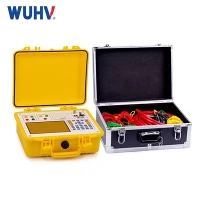


1. Resonance Test System
Definition: A general term for any system using the principle of resonance (AC or DC, series or parallel) for high-voltage testing.
Application: Can include transformer testing, cable withstand testing, GIS, CVT, etc.
Note: Broad and nonspecific; used as an umbrella term.
2. AC Resonance Test / AC Resonant Test System
Definition: A high-voltage test using an AC power source where resonance occurs between an inductive reactor and a capacitive test object.
Application: Especially suitable for long-length cables, GIS, transformers, or capacitive loads.
Standards: IEC 60060, IEC 60502, IEEE 400.3.
Output Voltage: Often ranges from 50 kV to 1000 kV or more.
3. Resonant Test System
Definition: Similar to "Resonance Test System" - often used interchangeably.
Note: Usually refers to AC test systems unless stated otherwise.
Used by: Manufacturers and testing professionals in high-voltage labs or on-site commissioning.
4. Variable Frequency Resonant / Variable Frequency Resonant Test
Definition: A type of AC resonant test system where the power supply frequency is adjustable (e.g., 30–300 Hz) to achieve precise resonance.
Key Advantage: Precise tuning to match various test object capacitances.
Application: Used in modern mobile resonant test systems for cable testing, GIS, transformers, etc.
5. CVT Resonance Test / AC Resonance Test for CVT
Definition: A specialized application of the AC resonance test used for Capacitive Voltage Transformers (CVTs).
Why Resonance is Needed: CVTs are highly capacitive, and resonance is ideal for testing them with lower input power.
Test Frequency: Usually at or near power frequency (50/60 Hz), or slightly variable to tune resonance.
Standard Reference: IEC 60044-5, IEC 61869-5.
6. Power Frequency Resonance Test
Definition: A resonant test conducted at power frequency (50 Hz or 60 Hz) rather than variable frequency.
Used When:
Regulatory or product standard demands power-frequency testing.
PD testing needs to replicate service conditions.
Application: Often for transformers, GIS, CVTs, and bushings.
Comparison Table
| Term | Frequency Type | Focus | Notes |
|---|---|---|---|
| Resonance Test System | AC or DC | General term | Broad category |
| AC Resonance Test / System | AC | HV cables, GIS | Series resonance |
| Resonant Test System | AC | General equipment | Synonym of the above |
| Variable Frequency Resonant | AC (30–300 Hz) | Field tuning | Modern systems |
| CVT Resonance Test | AC (50–300 Hz) | CVT only | Resonance helps due to high capacitance |
| AC Resonance Test for CVT | AC | CVT | Same as above |
| Power Frequency Resonance Test | AC (50/60 Hz) | Precision testing | Complies with service frequency |
How to Choose the Right Resonance Test System
| Requirement | Recommended System |
|---|---|
| Testing long HV cables | Variable Frequency AC Resonant Test System |
| Testing CVTs | AC Resonant System tuned for CVT capacitance |
| GIS & switchgear > 220 kV | Containerized or skid-mounted Resonance System |
| Transformer AC withstand test | Power Frequency Resonant System |
| Field commissioning (portable) | Modular AC Resonant Test Set |
| PD testing at service frequency | Power Frequency Resonance System |
Example Use Cases
| Test Target | Suitable System |
|---|---|
| 220 kV XLPE cable | AC Resonance Test with variable frequency |
| 330 kV CVT | CVT Resonance Test at 50 Hz |
| 400 kV GIS | Resonant Test System with PD-compatible output |
| Factory test of transformer | Power Frequency Resonance System |
| PD pre-check on cables | Variable Frequency AC Resonant Test with PD coupling capacitor |
Summary
All terms are variations or specific uses of resonant high-voltage test technology.
Most systems today use variable frequency AC resonance for flexibility and low input power.
Specialized tests like CVT or transformer testing may require power frequency resonance or tuned configurations.