

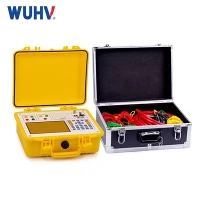


The no-load test, also known as the open-circuit test or excitation test, offers several advantages in evaluating the performance and characteristics of transformers. Some of the key advantages of the no-load test include:
Core Loss Measurement: The primary purpose of the no-load test is to determine the core losses of the transformer, which primarily consist of hysteresis losses and eddy current losses in the core material. By measuring the total losses when the transformer is energized with rated voltage and frequency but no load is connected, the core losses can be accurately determined.
Efficiency Calculation: The core losses obtained from the no-load test are crucial for calculating the transformer's efficiency under load conditions. By subtracting the core losses from the total losses measured under load conditions, the copper losses (including winding resistance losses) can be determined, allowing for accurate efficiency calculations.
Exciting Current Measurement: The no-load test also provides valuable information about the exciting current drawn by the transformer when energized with rated voltage and frequency. This current is necessary to establish the magnetic flux in the core and is influenced by core characteristics such as magnetic permeability and core geometry.
Insulation Assessment: The no-load test can help assess the insulation condition of the transformer windings by monitoring parameters such as the no-load current and voltage waveform. Variations in these parameters during the test may indicate insulation degradation or other issues affecting the transformer's performance.
Performance Verification: The no-load test is an essential part of routine testing and maintenance of transformers to verify their performance characteristics and ensure compliance with design specifications and standards. It helps assess the transformer's ability to operate efficiently under no-load conditions, which is essential for overall system reliability.
Diagnostic Tool: The results of the no-load test can serve as a diagnostic tool for identifying potential issues or abnormalities in transformer performance. Variations in core losses, exciting current, or other parameters measured during the test may indicate problems such as core saturation, winding insulation degradation, or core geometry issues.
Overall, the no-load test provides valuable information about the core losses, exciting current, and overall performance characteristics of transformers, making it an essential test for evaluating transformer efficiency, reliability, and condition.