

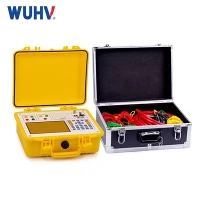


Resonant Testing is a high-voltage testing method used primarily for electrical equipment with significant capacitance, such as power cables, transformers, and gas-insulated switchgear (GIS). It leverages the principle of resonance in an LC circuit to efficiently generate high AC voltages required for testing insulation integrity without needing excessively large power supplies.
What Is Resonant Testing?
Definition:
A method where the test object (capacitive load) and a variable inductive reactor are connected in series or parallel to form a resonant circuit. The system is excited by an AC source at or near the resonant frequency.
Goal:
To apply a high, stable AC voltage across the equipment under test (EUT) to check for insulation withstand capability and detect insulation defects.
How It Works
The capacitance of the test object (e.g., a cable) forms one part of the resonant LC circuit.
An adjustable inductive reactor is tuned so the inductive reactance equals the capacitive reactance at the test frequency:

At resonance:
The circuit's impedance is minimized.
Voltage across the test object is magnified.
The input power is mainly to compensate for losses, making the system energy efficient.
Advantages of Resonant Testing
Energy Efficient: Requires lower input power compared to direct AC testing.
Voltage Control: Voltage can be precisely adjusted by changing frequency or reactor inductance.
Suitable for High-Capacitance Loads: Ideal for long cables and GIS equipment.
Produces Sine Wave Voltage: Simulates actual operating conditions closely.
Typical Applications
High voltage cables
Transformers
Gas Insulated Switchgear (GIS)
Rotating machines (motors and generators)
Standards
IEC 60060-3 - High voltage test techniques for resonant test systems
IEC 60840, IEC 62067 - Cable testing standards
IEEE 400.3 - Field testing of cable systems with resonant methods
Summary
| Aspect | Description |
|---|---|
| Method | Uses LC resonance between test object and reactor |
| Purpose | High AC voltage insulation testing |
| Benefit | High voltage with low power input |
| Common Equipment | Variable inductor (reactor), AC source, test object |
| Key Feature | Voltage magnification at resonance |