

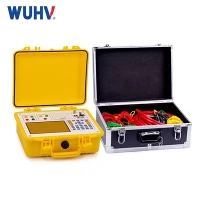


What is the Resonant Frequency Test Used For?
The resonant frequency test - specifically in AC resonant test systems - is used to perform high-voltage dielectric withstand testing by matching the resonance frequency of a test circuit (inductor + capacitive test object). It is a controlled and efficient method to test the insulation strength of high-voltage equipment.
Purpose of the Resonant Frequency Test
The resonant frequency test is used to:
| Objective | Explanation |
|---|---|
| Withstand Testing | To verify that insulation can sustain high voltage for a set duration (e.g., 1 hour), without breakdown |
| Partial Discharge (PD) Testing | To detect early insulation defects under clean sinusoidal AC at resonance |
| Minimize Power Requirements | Resonance allows high voltage output with lower input power, ideal for capacitive loads like cables |
| Ensure Safety Before Energization | Prevents future insulation failures by stress-testing under realistic voltage conditions |
| Commissioning & Factory Tests | Used in type, routine, and acceptance tests per IEC/IEEE standards |
How It Works Technically
The resonant frequency test tunes the system so:

Where:
L = Inductance of test reactor
C = Capacitance of the test object (cable, transformer, etc.)
At this frequency:
The circuit reaches series resonance
Voltage across the test object increases (due to Q-factor)
Input power is minimized
The test becomes highly stable, efficient, and controllable
Used For Testing These Assets
| Equipment | Standard Resonant Test Use |
|---|---|
| XLPE Power Cables (66 kV – 500 kV) | High-voltage withstand tests after laying (IEC 60840 / IEC 62067) |
| Transformers (HV & EHV) | Winding insulation testing without needing full power frequency |
| GIS & GIL | High voltage withstand and PD tests (IEC 62271) |
| Rotating Machines | Stator insulation testing (IEEE 433) |
| Bushings / Capacitor Banks | Voltage withstand testing with capacitive support |
| Shunt Reactors | HV tests by creating resonance with test reactor |
| Substation Equipment | Commissioning tests before grid energization |
Why Use Resonant Frequency Instead of Power Frequency?
| Reason | Benefit |
|---|---|
| Power Efficiency | Requires only a fraction of the power (input = ~5–10% of output) |
| Portable | Systems can be mounted on trailers for field use |
| Clean Waveform | Near-perfect sinusoidal voltage, essential for PD testing |
| Flexible Tuning | Adaptable to a range of test object capacitances |
| Cost-Effective | Cheaper than building power-frequency test stations for HV/EHV levels |
Summary
The resonant frequency test is essential for:
Safe commissioning of HV equipment
Factory quality control
Preventing future insulation failures
Conforming to IEC/IEEE testing standards