


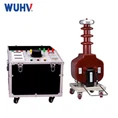
What is Meant by Resonance in AC?
In AC (Alternating Current) circuits, resonance refers to a condition in which the reactive effects of inductance (L) and capacitance (C) cancel each other out, resulting in the maximum voltage or current response at a particular frequency, known as the resonant frequency.
Types of AC Resonance
There are two main types:
| Type | Description |
|---|---|
| Series Resonance | Occurs when an inductor and capacitor are connected in series, and their reactances cancel out: XL=XCX_L = X_CXL=XC |
| Parallel Resonance | Occurs when L and C are connected in parallel and the circuit draws minimum current at resonance |
In high-voltage test systems like AC Resonant Test Systems, we use series resonance.
Mathematical Definition

Where:
f0= Resonant frequency (Hz)
L= Inductance (Henries)
C= Capacitance (Farads)
What Happens at Resonance in AC?
| Effect | Outcome |
|---|---|
| Impedance is minimized (series resonance) | Circuit allows maximum current flow |
| Voltage across L and C can be very high | Even if source voltage is low |
| Power factor = 1 | Current and voltage are in phase |
| Only resistive losses remain | Reactive power cancels out |
| Voltage across load is amplified | Very useful in high-voltage testing |
Why Is Resonance Important in High Voltage Testing?
In AC Resonant Test Systems, resonance is used to:
Amplify output voltage across a test object (like a cable or transformer)
Reduce input power requirements drastically
Allow safe and efficient testing with sinusoidal AC at high voltages
Enable long-duration withstand tests with stable, low-distortion voltage
Real-World Example
Imagine you want to test a 220 kV XLPE cable (capacitance: 0.2 µF). You combine it with an inductor (L: 15 H) to form a resonant circuit.
Calculate the resonant frequency:
f0=12π15×0.2×10−6≈29 Hzf_0 = \frac{1}{2\pi\sqrt{15 \times 0.2 \times 10^{-6}}} ≈ 29 \text{ Hz}f0=2π15×0.2×10−61≈29 Hz
At this frequency, the cable and inductor resonate, and a 200 kV test voltage can be achieved with only ~20 kVA input power.
Summary
Resonance in AC means the inductive and capacitive reactances cancel, allowing efficient voltage amplification and maximum energy transfer - a key principle used in AC resonant high-voltage testing systems.