


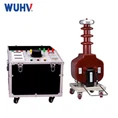
1. What is an AC Resonant Test System?
An AC Resonant Test System is a specialized high-voltage test system designed to perform withstand voltage testing using resonant circuits. It applies a high-purity sinusoidal voltage across the test object by tuning the resonance between the system's inductance (L) and the object's capacitance (C). These systems are commonly used for:
Type and routine testing of HV/EHV power cables
High-voltage transformers, GIS, bushings, insulators
On-site commissioning and diagnostic testing of substation components
It conforms to international test standards such as IEC 60502-2, IEC 60840, IEC 62067, and IEEE 400.4.
2. How Does an AC Resonant Test System Work?
At its core, the system creates a series-resonant LC circuit with:
L = Test system's HV inductor (reactor)
C = Capacitance of the test object
When the frequency is adjusted so that XL = XC, the circuit reaches resonance:

At this point:
The current becomes in-phase with the voltage (purely resistive)
Input current is minimal
Voltage across the test object rises sharply (amplified by Q factor)
Example:
To test a 500 m XLPE cable (C = 0.2 µF) at 200 kV:
Required reactor L is tuned at ~30 Hz
Input power can be as low as 20–30 kVA even though the output is 200 kV, 1 A (200 kVA)
3. Why Is AC Resonant Test System Important?
Allows long-duration high-voltage withstand testing
Minimizes thermal and electrical stress
Enables on-site testing without large grid-fed transformers
Reduces test system size and input power
Provides accurate assessment of insulation integrity
Helps identify weaknesses or voids in insulation before energization
4. Advantages of AC Resonant Test System
| Feature | Benefit |
|---|---|
| Low input power | Only needs to overcome system losses, not full output |
| Stable waveform | Low THD (<1%), ideal for partial discharge testing |
| Lower stress on components | Due to sinusoidal AC instead of DC/VLF waveform |
| Compact system | Especially with modular air-core or oil-immersed tank reactors |
| Safe resonance control | Automatic detuning upon flashover or overcurrent |
| Long test duration | Typically 1–60 minutes continuous operation |
5. Limitations of AC Resonant Test Systems
| Limitation | Explanation |
|---|---|
| Frequency-sensitive | Must tune exactly to achieve resonance; test object capacitance must be known |
| Initial cost | High upfront investment, though lower operational cost |
| Operator expertise | Requires trained personnel to calculate resonance and tune system |
| Not ideal for very low-C objects | Hard to tune with low capacitance (<50 pF) like bushings unless parallel capacitor is added |
6. Key Components and Their Roles
| Component | Description |
|---|---|
| Variable Frequency Power Supply (VFPS) | Converts grid input to tunable AC output (20–300 Hz typical) |
| Excitation Transformer | Steps up VFPS output to excite HV reactor |
| High-Voltage Reactor | Inductance element used to tune resonance; either tank-type (oil) or air-core |
| Test Object (C) | XLPE cable, transformer winding, GIS bus, etc. |
| Voltage Divider | Measures high voltage and provides feedback to control unit |
| Control Console (PLC/HMI) | Controls frequency, voltage, ramp rates, test duration, data logging |
| Discharge/Protection Unit | Discharges stored energy in test object/reactor post-test |
| Partial Discharge Coupling Capacitor (optional) | For PD test measurement per IEC 60270 |
7. Safety Precautions
| Area | Precaution |
|---|---|
| System Grounding | All components and test objects must be grounded properly |
| Emergency Shutdown | E-stop buttons and automatic shutdown on overvoltage/current |
| Interlocks | Ensure all doors, terminals, and connectors are secured before energizing |
| Discharge Units | Verify energy is discharged before contact; use motorized discharge sticks if needed |
| Monitoring | Use IR cameras and sensors during long-duration tests |
| Capacitance Verification | Always pre-calculate expected C to avoid mis-tuning or overvoltage |
8. Types of AC Resonant Test Systems
| Type | Description | Use Case |
|---|---|---|
| Tank Type (Oil-Insulated) | Compact, sealed tank with immersed reactor coil | HV/EHV cable testing, transformers, 200+ kV |
| Air-Core Modular | Stackable air reactors, lightweight and portable | MV/HV field tests, flexible for various C loads |
| Continuous Frequency | Tunable 20–300 Hz range | General-purpose, auto-tuning for any test object |
| Fixed Frequency (e.g. 50 Hz) | Used with specific object capacitance | Simplified design, less flexible |
| Trailer-Mounted | Entire system housed on a mobile trailer | Field deployment, long cables, power plants |
9. Comparison with Other Test Methods
| Method | Voltage Type | Frequency | Application | Pros | Cons |
|---|---|---|---|---|---|
| AC Resonant | Sine wave | Tunable (20–300 Hz) | HV/MV cable, GIS, TX | Low power, accurate, efficient | Costly, requires tuning |
| VLF | Sine/trapezoidal | 0.1 Hz | MV cables (≤69 kV) | Small, portable | Not representative for HV |
| DC | Unipolar | 0 Hz | Old method for cables | Simple, cheap | Not suitable for XLPE; insulation damage |
| Power Frequency | Sine | 50/60 Hz | Ideal waveform | Realistic test | Huge power source needed, not portable |
10. Core Applications of AC Resonant Test Systems
(1)High Voltage (HV) and Extra-High Voltage (EHV) Power Cables
Purpose: Type testing, routine testing, after-laying commissioning, and fault localization.
Standards: IEC 60840 (HV), IEC 62067 (EHV), IEEE 400.4
Voltage Range: 66 kV to 500 kV (and beyond)
Why AC Resonant?
XLPE cables have high capacitance; resonant testing reduces required power.
Long-duration (1 hour) withstand tests ensure insulation integrity.
Safer and less damaging than DC testing.
Typical Use Case: Testing a 220 kV XLPE underground cable after installation over 1.5 km with a mobile tank-type resonant system.
(2)Gas-Insulated Switchgear (GIS) and Gas-Insulated Lines (GIL)
Purpose: High-voltage withstand tests during commissioning or maintenance.
Standards: IEC 62271-203
Why AC Resonant?
GIS has complex geometry and insulation behavior; AC sinusoidal waveform represents actual stress conditions.
Supports partial discharge (PD) and lightning impulse superimposition tests.
Use Case: Field test of 400 kV GIS substation equipment before energization.
(3)Power Transformers (HV/EHV Class)
Purpose: Dielectric withstand testing of windings, bushings, and insulation oil.
Standards: IEC 60076-3
Why AC Resonant?
Used for winding insulation testing when the transformer core is bypassed or removed.
Allows precise voltage control and monitoring.
Enables PD or dissipation factor (tan δ) testing.
Use Case: Factory test of a 315 MVA, 500 kV transformer winding at 650 kV for 60 minutes.
(4)Rotating Electrical Machines (Generators and Motors)
Purpose: High-voltage AC withstand test of stator windings.
Standards: IEEE 433
Why AC Resonant?
Resonance allows full-voltage testing of large machines without drawing excessive current.
Ensures dielectric strength of stator insulation.
Use Case: On-site testing of a 300 MVA hydrogenerator stator after rewinding.
(5)Shunt Reactors and HV Capacitors
Purpose: Quality testing of high-reactance or high-capacitance devices.
Why AC Resonant?
Enables resonance between device and reactor/test circuit.
Helps identify winding insulation or internal partial discharge issues.
(6)Bushings and Insulators
Purpose: AC withstand and PD tests for ceramic or composite bushings.
Standards: IEC 60137
Why AC Resonant?
AC waveform stress better represents real operating conditions.
Allows clean waveform for PD testing at rated voltage.
For very low-capacitance objects like bushings, parallel capacitors may be added to reach resonance.
(7)Substation Equipment & Switchgear (AIS)
Purpose: Testing circuit breakers, disconnectors, and air-insulated switchgear at operating voltage.
Why AC Resonant?
Ensures insulation performance under peak voltage conditions.
Mobile systems can be deployed for in-situ tests in substations.
(8)Factory Acceptance Testing (FAT) and Type Testing
Industry Use: Manufacturers of cables, transformers, GIS, and insulators.
Why AC Resonant?
Factory testing under IEC or ANSI test protocols before shipment.
Full automation and data logging allow report generation and certification.
(9)On-Site Commissioning Testing
Why AC Resonant?
Portable (air-core or trailer-mounted) systems can be brought to installation site.
Used during grid expansion projects, wind farms, solar power stations, etc.
Use Case: Wind farm 132 kV export cable tested after trench laying using a mobile VF resonant system.
(10)UHV AC System Testing (Ultra High Voltage, ≥800 kV)
Why AC Resonant?
Power-frequency systems are too large or impractical at these voltages.
Resonant systems provide manageable solution with precise voltage control.
Industries That Use AC Resonant Test Systems
| Sector | Examples |
|---|---|
| Power Utilities | Grid operators (e.g., State Grid, TenneT, Hydro-Québec) |
| Cable Manufacturers | Nexans, Prysmian, LS Cable, Sumitomo |
| Transformer OEMs | Siemens, ABB, GE, TBEA |
| EPC Contractors | Larsen & Toubro, Hyosung, Hitachi Energy |
| Test Labs | CESI, KEMA, independent third-party labs |
| Renewables | Wind farm export systems, solar PV substations |
| Oil & Gas | Substation and cable testing for offshore rigs |
11. Future of AC Resonant Test Systems
Smarter Systems: Integration with AI for real-time analysis, predictive diagnostics
Remote Operation: Wireless, secure, and cloud-connected interfaces
SF6-Free Technologies: Eco-friendly reactor insulation alternatives
Automated Mobile Labs: Complete systems housed in trailers with robotic handling
Higher Voltage Ratings: Systems for UHV transmission (≥800 kV)
Advanced Monitoring: Real-time PD, tan delta, and harmonics built into test sequence
12. FAQs
Q1: What is the principle of an AC resonant test system?
A: It creates a series resonance circuit between an inductance (reactor) and the test object's capacitance. At resonance, voltage across the test object is amplified, and input power is minimized.
Q2: Why is resonance used in high-voltage testing?
A: It allows generation of high voltage using relatively low input power. This makes it ideal for testing large capacitive loads like XLPE cables with long lengths.
Q3: What frequency does an AC resonant test system operate at?
A: Typically 20–300 Hz. The system adjusts the frequency to achieve resonance based on the test object's capacitance.
Q4: Can it test equipment at power frequency (50/60 Hz)?
A: Yes, but typically at a lower or variable frequency for resonance. For pure 50 Hz tests, fixed-frequency test systems are used, which require much more power.
Q5: What is the Q factor in an AC resonant test system?
A: The quality factor (Q) measures resonance sharpness. Higher Q means lower input power needed to achieve a given output voltage. Q=ωL/RQ = \omega L / RQ=ωL/R
Q6: What happens during a breakdown in the test object?
A: The system detects the fault via overcurrent/overvoltage, and detunes the frequency to collapse the resonance, quickly reducing the output voltage.
Q7: Can AC resonant systems perform partial discharge (PD) testing?
A: Yes, especially with clean sinusoidal waveform systems. You need a PD detection system and a coupling capacitor with appropriate filters.
Q8: How do I calculate the required reactor size?
A: Use the resonance formula:

Where:
f = resonance frequency (Hz)
C = test object capacitance (F)
L = reactor inductance (H)
Q9: Can I use the system to test multiple devices in parallel?
A: Yes, as long as total capacitance is known and within the reactor's resonance tuning range. Total C = sum of all devices' capacitance.
Q10: What are typical system ratings?
Output voltage: 100–800 kV
Power: 100 kVA – 2 MVA
Frequency range: 20–300 Hz
Test duration: 1–60 minutes
Q11: Is the system portable?
A: Yes, especially modular or trailer-mounted systems designed for on-site testing of cables, transformers, GIS, and more.
Q12: What environment can it operate in?
A: Outdoor-capable systems (with IP-rated enclosures) operate in temperatures from -20°C to +55°C, humidity up to 95%, and altitudes up to 1000 m (higher with derating).
Q13: What input power is needed?
A: Depending on system size, input power ranges from 10–100 kVA for test systems rated to generate several hundred kV due to resonant gain.
Q14: Can it be remotely controlled?
A: Yes. Many systems support PLC + HMI control, remote operation via fiber links, and even SCADA integration.
Q15: What is the typical test time?
A: According to IEC 60840 and similar standards:
Withstand test: 1 hour
PD test: 10–30 minutes
Ramp up/down: several minutes depending on protocol
Q16: What standards does it comply with?
IEC 60840 / 62067 – HV/EHV cable testing
IEC 60270 – PD testing
IEC 60076-3 – Transformer testing
IEEE 400.4 – Field testing using AC resonant systems
IEC 62271 – GIS/GIL testing
IEEE 433 – Rotating machine testing
Q17: Is calibration required?
A: Yes. Voltage dividers, control units, and protection circuits must be calibrated regularly (typically annually) for traceability to national standards.
Q18: How do I select the right system for my application?
You'll need to know:
Test voltage
Capacitance of the test object
Required test duration
Power frequency or variable frequency
Indoor vs. outdoor use
I can help you size a system based on your exact parameters if needed.