

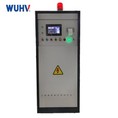
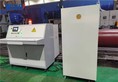
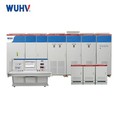
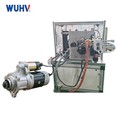


The UHV-109 CT/PT Polarity Tester is a multifunctional, intelligent, and portable device designed for comprehensive testing of current transformers (CTs) and voltage transformers (PTs). It integrates three key tests-volt-ampere characteristics (evaluating excitation performance and error limits), ratio testing (verifying transformation accuracy), and polarity testing (confirming winding phase relationships)-into a single system. With high-precision measurement, automated operation, and report generation capabilities, this instrument streamlines both field and laboratory testing while ensuring metering accuracy and relay protection reliability in power systems.
Product Parameters
| Item | parameter | |
| Working power supply | AC220V±10% ,50Hz | |
| Device output | 0 ~ 2500V (Current Max set 20A) | |
| High current output | 0~1000A | |
| Excitation measurement accuracy | ≤0.5%(0.3%* reading +0.2%* range) | |
| CT ratio
measurement |
The scope of | ≤5000A/1A(25000A/5A) |
| precision | ≤0.5% | |
| PT ratio
measurement |
The scope of | 5~220kV |
| precision | ≤0.5% | |
| The work
environment |
The temperature | -10℃ ~ 40℃ |
| humidity | ≤90% | |
| The altitude | ≤1000m | |
| size | 410mm × 260mm × 340mm | |
| The weight of the | ≤25kg | |
Battery Maintenance
1. Charge/Discharge Management:
Use the original charger for charging.
Avoid storing the instrument with a fully depleted battery for extended periods (weeks or months). For long-term storage, perform a full charge-discharge cycle every 2–3 months (fully charge the battery, use it until a low-battery warning appears, then recharge fully) to maintain battery health.
Avoid charging under extremely high or low temperatures.
2. Storage Charge Level:
Before long-term storage, charge the battery to approximately 50%–70%.
3. Replacement:
When battery runtime significantly degrades (e.g., below 70% of its original capacity) or noticeable swelling occurs, contact the manufacturer or an authorized service center for original battery replacement. Never use non-standard batteries.

Details


FAQS
6. Is automatic testing supported?
High-end UHV CT PT Testers support:
Automatic current/voltage ramping
Automatic ratio calculation
Automatic polarity detection
Automatic excitation curve scanning
Automatic report generation
📌 Benefit:
Reduces wiring errors and improves testing efficiency.
7. What is the purpose of excitation curve testing?
The excitation curve is used to evaluate CT core saturation behavior.
It provides:
Saturation point voltage
Core magnetic characteristics
Protection CT performance validation
👉 A key parameter in relay protection calibration.
8. Can multiple parameters be tested in one run?
Advanced UHV systems support one-step testing of:
Ratio
Polarity
Error
Excitation curve
Knee point voltage
Winding resistance
📌 One-button integrated testing is supported.
9. What software functions are included?
Standard functions:
Automatic CT/PT identification
Test report generation
Historical data storage
Curve analysis (excitation and error curves)
Export to Excel / PDF
Advanced options:
LIMS integration
Cloud data management
10. What is the testing speed?
Typical UHV performance:
CT test: 2–5 minutes
Excitation curve: 3–8 minutes
PT test: 1–3 minutes
👉 Batch testing mode supported.
Hot Tags: ct pt polarity tester, China ct pt polarity tester manufacturers, suppliers, factory


