

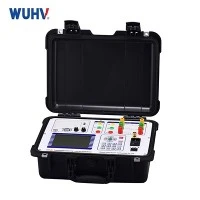


The SFRA Test device quantifies the response variations of the internal winding parameters of a transformer across different frequency domains. It evaluates the degree of change in the winding condition by analyzing the magnitude, amplitude distribution, affected frequency regions, and overall trend of the frequency response curves. Based on these results, it can be determined whether the transformer has suffered significant structural damage and whether major maintenance or repair is required.
As a professional SFRA Test device manufacturer and supplier in China, UHV focuses on delivering high-precision frequency response analysis, stable data acquisition, and reliable field performance for power utilities, transformer manufacturers, and testing laboratories worldwide.
Product Parameters
| Linear sweep frequency measurement range | (1kHz)~(1MHz) |
| Segment sweep frequency measurement range | (0.5kHz)~(1kHz) |
| (0.5kHz)~(10kHz) | |
| (10kHz)~(100kHz) | |
| (100kHz)~(500kHz) | |
| (500kHz)~(1000kHz) | |
| Range of amplitude | (-100dB)~(+20dB) |
| Accuracy of amplitude measurement | +20dB~-60dB;±1dB |
| -60dB~-100dB;±2dB | |
| Sweep accuray | 0.01% |
| signal input impedance | 1MΩ |
| signal output impedance | 50Ω |
| In phase test repetition rate | 99.5% |
| Measuring instrument size (L × W × H) | 300×340×120mm3 |
| Instrument aluminum alloy packing box size (L × W × H) | 310×400×330mm3 |
| Weight | 10kg |
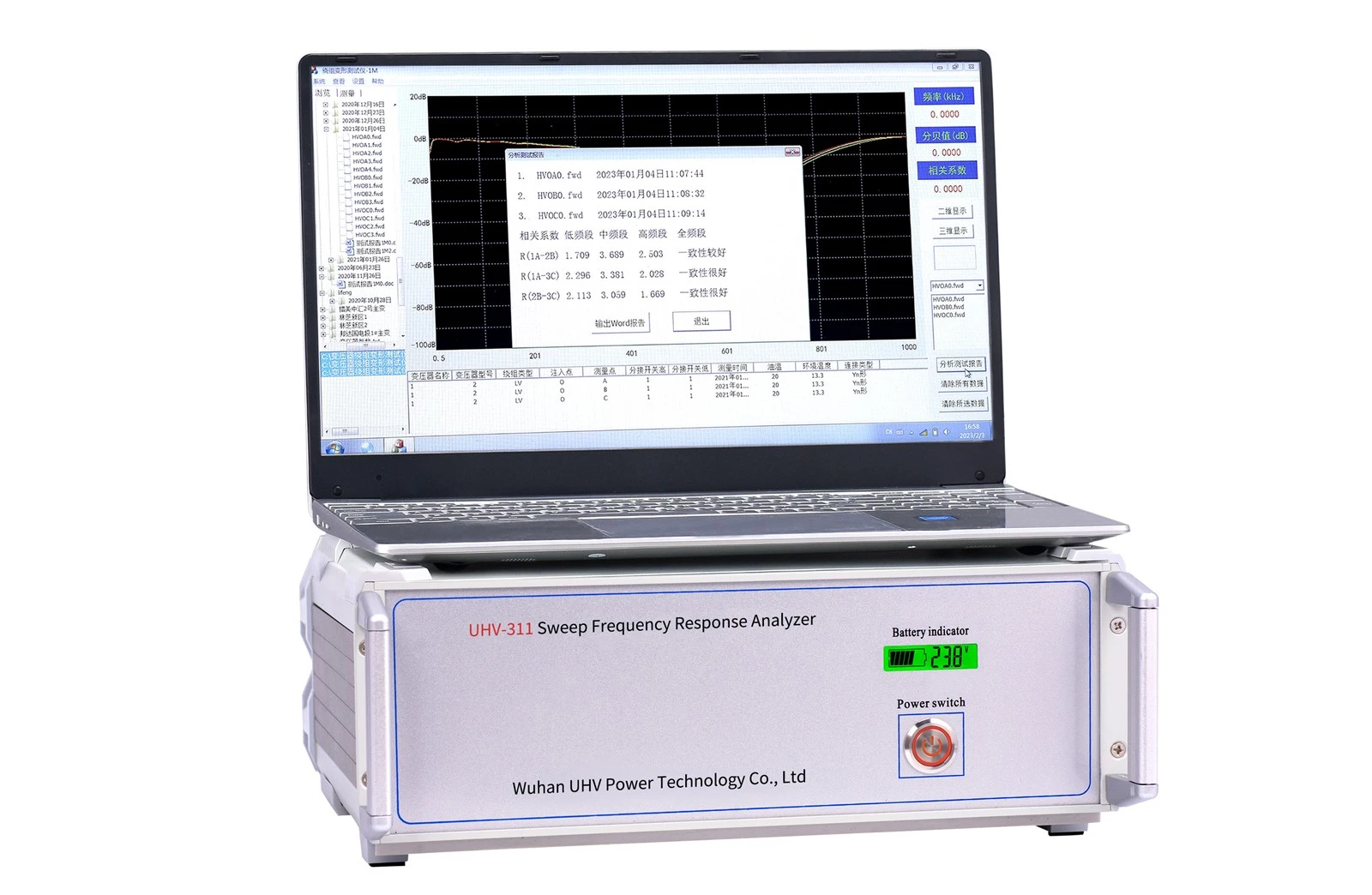

Main advantages of SFRA Test Device
1. Non destructive testing is the core feature, and the testing process does not require disassembling the transformer or applying high voltage. Evaluation can be completed through low-voltage sweep signals without affecting the normal operation of the equipment.
2. High sensitivity, able to identify subtle geometric changes in windings, such as small variations in the distance between winding lobes or slight bending of wires, which are difficult to detect in traditional DC resistance testing or insulation resistance testing.
3. Good repeatability, the test results of the same equipment at different time points are comparable, making it easy to establish long-term monitoring records and track the trend of changes in winding status.
4. The testing efficiency is high, and a single scan usually takes only a few minutes. The instrument is compact in size and easy to carry, making it suitable for on-site inspections.
5. Strong anti-interference ability, modern testing equipment adopts digital filtering and shielding technology, which can obtain stable data in electromagnetic noise environments such as substations.
6. The data storage and comparison function is complete, and the instrument can save multiple sets of historical curves, automatically calculate correlation coefficients or deviation indicators, and assist technicians in quickly locating abnormal frequency bands.
Application Areas of SFRA test device
1. Power substation: used for detecting the winding status of transformers before operation, after short-circuit faults, and during regular maintenance periods, to determine whether there is deformation or displacement in the windings.
2. Power equipment manufacturing plant: used for transformer factory testing, manufacturing quality inspection, and comparison of status before and after transportation, to assist in evaluating whether the mechanical structure of the winding has changed.
3. Power maintenance and repair unit: After the transformer experiences short-circuit impact, abnormal operation, or fault repair, check whether there is potential mechanical damage to the winding by comparing the frequency response curve.
4. Third party power testing institutions: used for preventive testing, status assessment, and fault diagnosis of transformers, providing testing basis for equipment maintenance and operation.
5. Large industrial enterprises: suitable for places with transformer equipment such as power plants, steel plants, petrochemical enterprises, mines, etc., to help operation and maintenance personnel grasp the operating status of transformer windings.
6. Transformer transportation and installation site: By comparing the test data before and after transportation, it can assist in determining whether there may be any changes in the mechanical structure of the winding during transportation, lifting, or installation..
Typical Case
This SFRA Test Device has been applied in multiple on-site testing scenarios, and the following are two representative practical cases:
Case 1: State assessment of 110kV main transformer after short-circuit impact. A 110kV main transformer in a substation in a certain area was impacted by short-circuit current due to a line fault. To ensure the safety of the equipment, the testing personnel conducted an emergency test on the transformer using the Wuhan UHV winding deformation tester. By collecting and comparing the frequency response data of the three-phase winding horizontally, it was found that one phase had a resonance point offset phenomenon in the mid to high frequency range. Based on this discovery, the user arranged further tracking and monitoring of the transformer, providing necessary technical basis for subsequent maintenance decisions.
Case 2: Network access testing of newly built data center distribution transformers. Before being put into operation, a large data center needs to conduct a winding status survey on its 20 10kV dry-type distribution transformers. The testing team used this tester to complete the winding deformation testing of all transformers and established an initial state database for the equipment, providing benchmark data for future preventive tests.
How to Select The SFRA Test Device
1. Choose According to the Transformer Type
First, identify the type of transformer to be tested, such as a power transformer, distribution transformer, or another type of transformer requiring winding condition assessment. Different transformers have different winding structures, capacities, and voltage ratings, so the tester must be suitable for the intended application.
2. Select the Appropriate Testing Method
Frequency Response Analysis (FRA) is a commonly used method for detecting transformer winding deformation. Before purchasing a tester, check its measurement principle and whether it can compare frequency response curves to identify potential winding displacement, deformation, or other mechanical abnormalities.
3. Check Measurement Accuracy and Data Analysis Functions
Choose a tester with a suitable frequency range, good measurement repeatability, and reliable interference resistance. Useful functions include curve display, data storage, historical data comparison, and test report generation. These features help technicians evaluate changes in winding conditions and identify potential problems.
4. Consider Field Testing and Operation Requirements
For substation maintenance and on-site inspections, a portable tester with convenient wiring and straightforward operation is a practical choice. Transformer manufacturers and professional testing laboratories may place greater emphasis on multi-winding testing efficiency, batch data management, and test report generation.
5. Check Standards Compliance and After-Sales Support
Before purchasing, confirm which testing standards the equipment supports. It is also worth checking whether the manufacturer provides operating training, software updates, technical support, and calibration services.
6. Select the Configuration Based on the Application
Power utilities and maintenance teams: Focus on portability, measurement stability, and historical curve comparison.
Transformer manufacturers: Prioritize testing efficiency, data management, and batch testing capabilities.
Third-party testing laboratories: Pay particular attention to measurement repeatability, report export functions, and compliance with relevant testing standards.
Frequently Asked Questions
1. When is it necessary to conduct a winding deformation test?
Common application scenarios include:
Transformer pre delivery inspection
Handover test after transformer installation
After a short circuit fault occurs in the transformer
After the transformer is subjected to a large current surge
After transportation or long-distance transfer of transformers
Before and after transformer overhaul
Evaluation of Transformer Operation Status
Fault diagnosis of transformer accidents
2. Is the device operation complicated?
The SFRA test device adopts a computer or embedded control system, equipped with an intuitive software operation interface. Testers can follow the device prompts to complete wiring, parameter settings, and testing, and can automatically generate test curves and save test results.
3. Does the transformer winding deformation tester (SFRA test device) support an English operating interface?
For export market equipment, Chinese/English operating interfaces or corresponding software language support can be provided according to customer needs. The specific language configuration can be confirmed during procurement.
4. What industries are suitable for SFRA test devices?
Mainly used in power companies, substations, power plants, transformer manufacturing enterprises, power maintenance companies, electrical testing institutions, and scientific research units for transformer production testing, handover testing, preventive testing, and fault diagnosis.
5. Can the SFRA test device be customized?
Corresponding configuration plans can be provided according to different project requirements, such as testing channels, software functions, data interfaces, operating languages, equipment structures, and supporting accessories. For overseas projects, corresponding solutions can also be provided based on local power standards and on-site testing requirements.
6. What is the after-sales service for SFRA test device?
We can provide technical consultation, operation training, installation and debugging guidance, remote technical support, equipment maintenance, software upgrades, and calibration services. Export projects can also provide English technical materials, operation manuals, and remote after-sales support according to customer needs.
We are a professional SFRA test device manufacturer in China. We can provide the best professional SFRA test device for sales and competitive price. If you are looking for SFRA test device supplier, we are a good choice.
Contact us to get SFRA test device price.
Hot Tags: sfra test device, China sfra test device manufacturers, suppliers, factory, Heavy-Duty Transformer Oil Tan Delta Tester


