

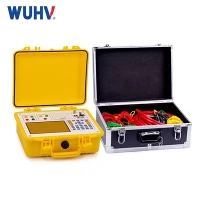


A Transformer Winding Deformation Tester is a precision diagnostic instrument used to detect mechanical deformation or displacement in the windings of power transformers, including high-voltage (HV), medium-voltage (MV), low-voltage (LV), and tap-changer windings. It is used to assess the mechanical integrity of transformer windings, identify potential fault risks at an early stage, prevent catastrophic failures such as short circuits or explosions caused by winding deformation, and ensure the safe and stable operation of the power grid.
As a professional transformer testing equipment manufacturer and supplier in China, UHV focuses on providing high-precision diagnostic solutions for winding deformation detection, supporting utilities, transformer manufacturers, and maintenance service providers with reliable condition assessment tools for power system safety.


Technical parameter
| Linear sweep frequency measurement range | (1kHz)~(1MHz) |
| Segment sweep frequency measurement range | (0.5kHz)~(1kHz) |
| (0.5kHz)~(10kHz) | |
| (10kHz)~(100kHz) | |
| (100kHz)~(500kHz) | |
| (500kHz)~(1000kHz) | |
| Range of amplitude | (-100dB)~(+20dB) |
| Accuracy of amplitude measurement | +20dB~-60dB;±1dB |
| -60dB~-100dB;±2dB | |
| Sweep accuray | 0.01% |
| signal input impedance | 1MΩ |
| signal output impedance | 50Ω |
| In phase test repetition rate | 99.5% |
| Measuring instrument size (L × W × H) | 300×340×120mm3 |
| Instrument aluminum alloy packing box size (L × W × H) | 310×400×330mm3 |
| Weight | 10kg |
Main functions and features of Transformer Winding Deformation Tester
High precision measurement: Using advanced measurement technology and high-speed, highly integrated microprocessor design, it can accurately draw the frequency domain response curves of each phase, and accurately determine the deformation degree of the transformer through horizontal and vertical comparison of the measurement curves.
Multiple scanning methods: Testers are usually equipped with multiple scanning methods, such as linear scanning and segmented scanning, to meet different testing needs. High scanning frequency accuracy ensures the accuracy of test results.
Wide measurement range: The measurement range is usually wide and can cover various situations of transformer winding deformation.
Powerful analysis function: equipped with powerful upper computer software, capable of performing curve analysis, printing, and generating Word documents and other operations. The software interface is user-friendly and easy to operate, allowing users to easily analyze and process test data.
Portable design: Testers usually adopt a split structure, with USB connection between the testing host and the main control computer, plug and play. The on-site wiring is simple, easy to use, and suitable for various on-site testing environments.
Reasons for detecting winding deformation
Transformers may experience various mechanical stresses or electromagnetic force impacts during operation or transportation, such as:
Short-circuit fault current surges: The most common cause. High short-circuit electromagnetic forces subject windings to extreme mechanical stress, potentially causing displacement, twisting, bulging, or inter-turn short circuits.
Collisions or shocks during transportation or installation.
Incorrect operations (e.g., improper on-load tap changer operation).
Accumulated vibration during long-term operation.
Manufacturing defects.
Winding deformation changes the distributed capacitance and inductance between windings, thereby altering their frequency response characteristics. Minor deformation may not immediately affect operation; however, it significantly reduces the transformer's insulation strength and short-circuit withstand capability, greatly increasing the risk of future failures.
Primary Application Scenarios of Transformer Winding Deformation Tester

Preventive maintenance testing: Regular testing to establish baseline data and monitor changes in winding condition.
Post-fault diagnosis: Assessing winding damage and its extent after a transformer experiences external short circuits or overcurrent surges.
Factory acceptance testing (FAT): Verifying the structural integrity of new transformer windings.
Post-installation/transportation acceptance: Confirming whether windings have been damaged during transportation or installation.
Pre-/post-repair assessment: Comparing results before and after maintenance (especially tank or core lifting operations) to confirm repair effectiveness or identify new issues.
Condition assessment: Serving as a key indicator in comprehensive transformer condition evaluation.


faq
1. Why do transformers need to undergo winding deformation testing?
After a transformer experiences a short circuit fault or is subjected to significant electrical impact, the winding may exhibit mechanical deformation that is difficult to detect with the naked eye. Winding deformation testing can diagnose the winding status without disassembling the transformer, which helps to detect potential faults in advance and reduce equipment operation risks.
2. What transformers is the transformer winding deformation tester suitable for?
Usually applicable to power transformers, distribution transformers, special transformers, and other transformers with winding structures. The corresponding testing method and wiring method can be selected according to the structure and testing requirements of the tested transformer.
3. How to determine if the winding has deformed based on the test results?
Usually, judgment is made by comparing the changes in the test curve, including curve amplitude, frequency response characteristics, and differences in curves between different phases. Actual diagnosis also requires comprehensive analysis based on transformer model, historical test data, factory data, and other test results.
4. What should be noted during the testing process?
Before testing, it should be confirmed that the transformer is reliably powered off, fully discharged, and grounded, and the test line should be connected correctly according to the equipment manual. At the same time, non-standard wiring should be avoided in strong electromagnetic interference environments to ensure the stability and accuracy of test data.
5. Can the data from the transformer winding deformation tester be exported?
Okay. According to the specific model, the device can support USB, computer connection, or other data interfaces for testing data transmission, making it convenient for users to backup data, create reports, and compare historical data.
6. What parameters should be considered when purchasing a transformer winding deformation tester?
Suggested focus:
Test frequency range
Frequency resolution
Test signal amplitude
Measurement accuracy
Data collection method
Anti-interference capability
Number of testing channels
Data storage capacity
Data export method
Software analysis function
Operating Interface
Equipment portability
Calibration and after-sales service
We are a professional transformer winding deformation tester manufacturers in China.We can provide the best professional transformer winding deformation tester for sales and competitive price. If you are looking fortransformer winding deformation tester supplier, we are a good choice.
Contact us to get transformer winding deformation tester price.
Hot Tags: transformer winding deformation tester, China transformer winding deformation tester manufacturers, suppliers, factory, Heavy-Duty Transformer Oil Tan Delta Tester


