


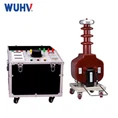
1. What is an Interfacial Tension Tester?
An Interfacial Tension Tester measures the tension at the interface between two immiscible liquids, typically oil and water. It evaluates the ability of a liquid (e.g., transformer oil) to resist contamination or degradation.
2. Why is interfacial tension (IFT) important in transformer oil?
Indicates the cleanliness and aging condition of insulating oil
Low IFT suggests contamination by polar compounds (e.g., oxidation products)
Helps assess oil quality and when it should be reclaimed or replaced
Monitors oil deterioration over time
3. What does interfacial tension measure?
IFT measures the force per unit length (mN/m) acting along the line of contact between two liquids. It reflects how strongly molecules of one liquid are attracted to another.
4. What is the typical IFT value for new transformer oil?
New mineral insulating oil: > 40 mN/m
Aged or oxidized oil: < 25 mN/m
Most standards recommend a minimum of 25–30 mN/m for in-service oils
5. Which test methods are commonly used?
| Method | Description |
|---|---|
| ASTM D971 | Standard test for IFT of oil against water using a ring method |
| ISO 6295 | Similar to ASTM D971; international standard |
| IEC 62961 | Applies to insulating liquids for electrical equipment |
6. How does an interfacial tension tester work?
Uses the Du Noüy ring method:
A platinum ring is immersed in the interface between oil and water.
It is slowly pulled upward.
The maximum force required to detach the ring is measured.
This force is converted into IFT value using a calibration factor.
7. What units are used in IFT testing?
Measured in mN/m (millinewtons per meter)
Older literature may refer to dynes/cm (1 mN/m = 1 dyne/cm)
8. What kind of samples are tested with an IFT tester?
Mineral insulating oils (transformers, capacitors)
Synthetic insulating liquids
Petroleum products
Surfactants, emulsifiers, detergents
Used oil samples (for degradation analysis)
9. What are the main types of IFT testers?
| Type | Description |
|---|---|
| Manual | Requires user operation and visual judgment |
| Semi-automatic | Motorized ring movement, manual interface |
| Fully automatic | Digital force sensors, ring positioners, and auto-calculation |
| Optical/Drop shape | Measures surface tension using droplet profile (alternate method) |
10. What features do modern automatic IFT testers offer?
✅ Digital force sensors
✅ Programmable test cycles
✅ Built-in temperature control (e.g., 25 °C ± 0.1 °C)
✅ Data logging and report generation
✅ Automatic ring cleaning functions
✅ Compliance with ASTM D971 / ISO 6295
11. What are common causes of low IFT values in oil?
Oxidation byproducts (acids, sludge)
Water contamination
Dissolved polar contaminants
Decomposition products from overheating
12. Who uses IFT testers?
Power utilities and transformer manufacturers
Oil testing labs
Petroleum refineries
Chemical and surfactant R&D labs
QA/QC teams in oil processing plants
13. What is the Du Noüy ring made of and why?
Platinum-iridium alloy, often coated in platinum wire
Chemically inert, corrosion-resistant, and maintains accurate shape
Can be cleaned and reused repeatedly
14. How often should the instrument be calibrated?
Annually, or per lab SOP
Calibration involves standard weights or force sensors
Ring geometry must be verified with standard reference liquid
15. Which companies manufacture IFT testers?
If you are looking for Interfacial Tension Tester manufacturers and suppliers, please feel free to contact us for high quality and good price, we have various types of tester for sales to solve your problems.
Our company has been specializing in the production and manufacturing of frequency series resonance devices for 21 years. We operate a modern intelligent factory covering over 4000 square meters, equipped with more than 100 automated production, manufacturing, assembly, and testing machines. We have obtained CE certification and currently serve the over the word customers .
16. What are best practices for IFT testing?
Use fresh distilled water (ASTM Type II or better)
Clean the ring thoroughly after every test
Degas the oil sample if necessary
Ensure no air bubbles or contamination in sample
Maintain test temperature at 25 °C for standard compliance