

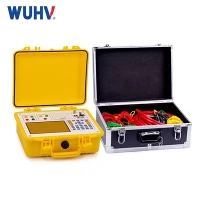


A DLRO, which stands for Digital Low Resistance Ohmmeter, is a specialized instrument used for accurately measuring low resistance values in electrical conductors, components, and circuits. DLROs are designed to provide precise measurements in the milliohm (mΩ) and microohm (µΩ) range, making them ideal for applications where traditional multimeters or ohmmeters are not sensitive enough.
DLROs are primarily used for the following purposes:
Quality Assurance and Testing: DLROs are used in manufacturing and quality assurance processes to verify the integrity and quality of electrical conductors, such as wires, cables, and busbars. By measuring the resistance of these conductors, DLROs ensure that they meet specified design requirements and standards.
Maintenance and Troubleshooting: DLROs are used for maintenance and troubleshooting of electrical systems and components, particularly in industries where low resistance connections are critical for safety and reliability. DLROs can detect and diagnose issues such as loose connections, faulty joints, and damaged conductors.
Transformer and Motor Testing: DLROs are used to measure the DC resistance of transformer windings, motor windings, and other coils to assess their condition and detect any faults or defects. By measuring the resistance of these components, DLROs can identify problems such as shorted turns, open circuits, and insulation deterioration.
Switchgear and Circuit Breaker Testing: DLROs are used to measure the contact resistance of switchgear, circuit breakers, and other electrical contacts to ensure proper operation and prevent overheating. DLROs can detect issues such as high resistance contacts, which can lead to increased power loss and decreased efficiency.
Aerospace and Aviation Applications: DLROs are used in aerospace and aviation industries to test the integrity of electrical connections, bonding straps, and grounding systems, where low resistance values are critical for safety and reliability.
DLROs typically use a four-wire Kelvin method (Kelvin connection) to minimize lead resistance and ensure accurate measurements, especially at very low resistance values. They may also feature high-current sources or built-in power sources to generate a known test current for accurate resistance measurements.
Overall, DLROs are essential tools for quality assurance, maintenance, troubleshooting, and performance verification in various industries and applications where precise measurement of low resistance values is critical.