

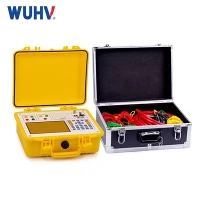


AC (Alternating Current) Hipot testing and DC (Direct Current) Hipot testing are two methods used for evaluating the insulation integrity of electrical components and systems. The key differences between AC and DC Hipot testing include the type of voltage applied, testing objectives, and the characteristics of the tests:
Type of Voltage Applied:
AC Hipot Testing:
Voltage Type: AC Hipot testing involves applying a high-voltage alternating current to the equipment under test. The AC voltage is typically sinusoidal in nature.
Waveform: The waveform of the AC voltage is characterized by periodic changes in direction, oscillating between positive and negative polarities.
DC Hipot Testing:
Voltage Type: DC Hipot testing involves applying a high-voltage direct current to the equipment under test. The DC voltage remains constant in polarity throughout the test.
Testing Objectives:
AC Hipot Testing:
Objective: AC Hipot testing is primarily conducted to assess the dielectric strength of the insulation under AC voltage stress. It helps identify potential weaknesses, breakdown points, or insulation issues when subjected to alternating current.
DC Hipot Testing:
Objective: DC Hipot testing is performed to evaluate the dielectric strength of the insulation under DC voltage stress. It assesses the insulation's ability to withstand a constant DC voltage without breakdown.
Sensitivity to Insulation Issues:
AC Hipot Testing:
Sensitivity: AC Hipot testing is generally more sensitive to certain types of insulation issues, such as partial discharge under alternating voltage stress. It can reveal weaknesses in insulation that may not be apparent under DC testing.
DC Hipot Testing:
Sensitivity: DC Hipot testing is effective in detecting insulation issues that may manifest under steady DC voltage stress. It is particularly useful for assessing the insulation integrity of equipment operating under DC conditions.
Waveform Effects:
AC Hipot Testing:
Waveform Effects: AC Hipot testing exposes the insulation to the cyclic stress of the AC waveform. This can reveal weaknesses that may be affected by the changing polarity of the voltage.
DC Hipot Testing:
Waveform Effects: DC Hipot testing subjects the insulation to a constant DC voltage. It may uncover issues that are influenced by the continuous stress of a unidirectional electric field.
Applications:
AC Hipot Testing:
Applications: AC Hipot testing is commonly applied to electrical components and systems that operate under AC conditions. This includes cables, transformers, switchgear, and other AC-powered devices.
DC Hipot Testing:
Applications: DC Hipot testing is used for electrical components and systems that operate under DC conditions. This includes DC cables, DC motors, generators, and other DC-powered equipment.
Equipment Design:
AC Hipot Testing:
Equipment Design: AC Hipot testers are designed to generate high-voltage AC waveforms for testing purposes. They include safety features and controls for adjusting the test parameters.
DC Hipot Testing:
Equipment Design: DC Hipot testers are designed to generate high-voltage DC for testing insulation. They include features for controlling the DC voltage and monitoring test parameters.
In summary, AC Hipot testing and DC Hipot testing differ in terms of the type of voltage applied, testing objectives, sensitivity to insulation issues, waveform effects, and applications. The choice between AC and DC testing depends on the specific requirements of the equipment being tested and the operating conditions it will experience in service.