

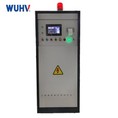
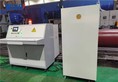
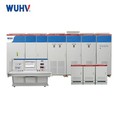
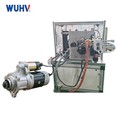


Product introduction
Partial discharge (PD) is a partial, non penetrating discharge phenomenon that occurs inside or on the insulation surface of high-voltage electrical equipment (such as transformers, cables, GIS, motors, etc.). It is an important early sign of insulation degradation, and long-term development can lead to insulation breakdown, equipment failure, and even power outages. The partial discharge detection system is a device specifically designed to monitor, identify, and locate this discharge phenomenon, and is one of the core technologies for power equipment status monitoring and fault diagnosis.

Product Parameters
| Technical Characteristics | |
| Number of channels | Independent 2-channelC |
| Sample Rate | Up to 10M |
| Sampling precision | 12bit |
| Range switching | -40dB,-20dB,0dB,20dB,40dB,60dB total 6 levels |
| Measurement frequency band | 3dB bandwidth 10kHz~1MHz |
| Digital filtering | 10kHz~1MHz optional |
| Segmented programmable filter | Low end frequency:10kHz,20kHz,40kHz,80kHz |
| Low end frequency:10kHz,20kHz,40kHz,80kHz | |
| Nonlinear error of this range | 10% |
| Measuring range | 0.1pC~100,000pC |
| Sensitivity | 0.1pC |
| The capacitance range of the testable product | 6pF~250µF |
| Test power frequency range | 50~500Hz |
| Display | |
| Display | 12"TFT true color touch LCD display screen |
| Resolution | 1024 × 768 |
| Interface | |
| USB | 3 channels, capable of external mouse and keyboard, as well as external mobile storage devices |
| Power Mode | AC 220V;frequency 50Hz;Power 300W |
| Electrical signal interface | 2-channel BNC interface for signal input |
| Optical signal interface | 2 channels, used for signal input |
| Network interface | 1 channel |
| Grounding button | External grounding |
| General Instructions | |
| CPU | dominant frequency 1.60GHz |
| Memory | 2.0GB |
| Hard disk | 128GB Solid state drive |
| System | Windows Xp |
| Work environment | ambient temperature:-10~45℃ |
| relative humidity:≤95% | |
| Size | L×W×H:474mm × 288mm × 370mm |
| Net weight | 15.8kg |
Core functions
1. Detection: Capture PD signals sensitively and reliably.
2. Interference suppression: Hardware filtering (bandpass, high pass, low-pass), digital signal processing (DSP) algorithms (such as wavelet transform, digital filtering), and other methods are used to suppress background noise and interference.
3. Feature extraction: Calculate basic parameters such as the amplitude (intensity), phase (position relative to the power frequency voltage), and repetition rate (number of discharges per second) of the discharge.
4. Pattern recognition: Based on the phase distribution map (φ - q-n) of discharge, pulse waveform, statistical features, etc., use expert systems, neural networks, support vector machines and other methods to identify discharge types (such as internal discharge, surface discharge, corona discharge, floating potential discharge).
5. Severity assessment: Based on the discharge capacity (pC), discharge energy, development trend, etc., evaluate the degree of harm of discharge to equipment insulation.
6. Localization: Using time differences (such as UHF, ultrasound), signal strength (such as TEV scanning), or multiple methods of fusion, determine the specific location of the PD source inside the device.
7. Alarm and Diagnosis: Based on preset thresholds or intelligent analysis results, trigger alarms and provide diagnostic reports.
8. Data management and trend analysis: Store historical data, draw discharge parameter trend charts, and evaluate insulation state changes.
Application scenarios
Factory test and acceptance test: Ensure the insulation quality of new equipment.
Handover test: Inspection before equipment installation and operation.
Preventive testing: Regular offline testing.
Online monitoring: Continuous or periodic real-time monitoring of important equipment such as large transformers, GIS, and high-voltage cables.
Fault diagnosis: Find the cause when the equipment is abnormal.
Verification after maintenance: Confirm whether the defects have been eliminated after maintenance.

Summary:
Partial discharge detection system is a key technical equipment to ensure the safe and reliable operation of power equipment. By capturing and analyzing partial discharge signals, it can effectively warn of insulation faults, achieve predictive maintenance of equipment, and significantly reduce accident risks and maintenance costs. With the continuous development of sensor technology, signal processing technology, and artificial intelligence, partial discharge detection systems are rapidly evolving towards higher sensitivity, stronger anti-interference ability, more intelligent diagnosis, and wider online applications. Choosing appropriate detection methods (or combinations) and systems is crucial for different device types and application scenarios.


Hot Tags: partial discharge detection system, China partial discharge detection system manufacturers, suppliers, factory


