

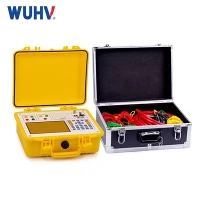


Product introduction
A Transformer Comprehensive Test Bench is a highly integrated, automated, dedicated equipment system used for conducting a full range of tests on power transformers (including distribution transformers, power transformers, special transformers, etc.). These tests encompass factory acceptance tests (FAT), type tests, commissioning/acceptance tests, and preventive maintenance tests.

Product Parameters of Transformer Comprehensive Test Bench
scanning way:(The instrument has a linear sweep measurement system and a segmented sweep measurement system )
| project | Measuring range | relative error |
| Voltage | 0.1~600V | ±(0.2% reading +0.1% range) |
| current | 0.1~200A | ±(0.2% reading +0.1% range) |
| Power | U*I | ±(0.2% reading +0.1% range) |
| Power factor | 0.1~0.9999 | 3 Digital |
| power supply | AC220V±10% 50Hz±2% | |
| Use environment | Operating temperature range 0~40℃ Relative humidity 30%~90% | |
| volume | 2500╳1060╳1500(mm) | |
| Weight | 100kg~1000kg(Change according to custom requirements) | |
Core Testing Functions (Typically include one or more of the following) of Transformer Comprehensive Test Bench

1.Voltage Ratio and Vector Group Test: Precisely measures the voltage ratio (turns ratio) between transformer windings and the connection vector group (e.g., Dyn11, Yyn0), verifying design parameters and correct number of turns.
2.Winding Resistance Test (DC Resistance): Measures the DC resistance of transformer windings (including HV, MV, LV, neutral point, and all tap changer positions). Used to check winding conductor weld quality, contact integrity, inter-turn shorts, tap changer contact resistance, etc.
3.Insulation Characteristics Tests:
Insulation Resistance (IR) & Absorption Ratio (DAR)/Polarization Index (PI): Measures IR values between windings and between windings and ground (core/clamps/tank), along with their change over time (DAR/PI), assessing overall moisture ingress, contamination, or degradation of insulation.
Dielectric Dissipation Factor (tan δ) and Capacitance (C): Measures tan δ and capacitance between windings and between windings and ground. tan δ is a highly sensitive indicator for assessing aging, moisture, and degradation of insulation materials (oil-paper insulation).
4.No-Load Loss and No-Load Current Test: Measures the active power input (no-load loss) and current (no-load current) when rated voltage at rated frequency is applied to one winding (usually HV) with the other winding(s) open-circuited. Used to verify core design, manufacturing quality (e.g., core steel grade, joints), and detect core multi-point grounding or local short-circuit faults.
5.Load Loss and Impedance Voltage (Short-Circuit Impedance) Test: Measures the active power input (load loss) and applied voltage (used to calculate impedance voltage percentage) when one winding (usually LV) is short-circuited and rated frequency current (typically rated current or a proportion) is applied to the other winding (usually HV). Used to verify winding design, detect winding deformation or displacement, and calculate transformer efficiency and voltage regulation.
6.Power Frequency Withstand Voltage Test: Applies power frequency AC voltage significantly higher than the operating voltage to transformer windings and insulation structures for a specified duration, testing the strength of main insulation (e.g., winding-to-ground, phase-to-phase, between windings of different voltage classes).
7.Induced Voltage Withstand Test: Primarily used to test the longitudinal insulation (inter-turn, inter-layer, inter-section insulation) of windings. Typically achieved by increasing frequency (e.g., 100Hz, 200Hz) or voltage magnitude (often using a frequency multiplying power supply).
8.Partial Discharge (PD) Measurement: Detects and locates small electrical discharges within the insulation structure that do not bridge the electrodes. PD is a critical precursor and cause of insulation deterioration and a key indicator for assessing transformer insulation condition and expected lifespan. (Usually requires supplementary equipment like PD-free power supply and coupling capacitors).
9.On-Load Tap Changer (OLTC) Test: Specifically designed for testing OLTCs in tap-changing transformers. Includes:
Switching Characteristic Test: Measures transition time, transition resistor values and their change curves, contact timing sequences, etc.
Operation Cycle Counter / Drive Motor Test, etc.
10.Winding Deformation Analysis (WDA) / Frequency Response Analysis (FRA): Diagnoses potential mechanical deformation faults (displacement, buckling, twisting) in windings caused by short-circuit currents or transport impacts by measuring the winding's frequency response (sweep frequency impedance method) and comparing it to the original fingerprint or standard.
11.Temperature Rise Test (Supported or simplified by some advanced benches): Measures the temperature rise of windings and oil when the transformer operates under rated load until thermal stability is reached. Requires prolonged operation and auxiliary heating/loading equipment.
12.Other Auxiliary Tests: Such as voltage vector check (phase sequence/angle), built-in CT/PT verification, bushing capacitance and tan δ test, core ground current measurement, etc.


We are a professional Transformer Comprehensive Test Bench manufacturers/Transformer Comprehensive Test Bench suppliers in China.
Contact us to get Transformer Comprehensive Test Bench price.
Hot Tags: transformer comprehensive test bench, China transformer comprehensive test bench manufacturers, suppliers, factory, transformer test system, transformer testing lab


