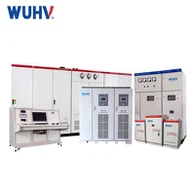

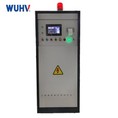
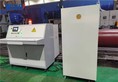
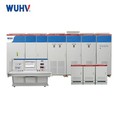
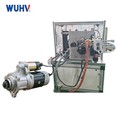


Product introduction:
The entire system of the DC motor test bench is fully automated, computerized, and efficient, with anti misoperation safety function design. English interface operation, automatic collection of measurement data, automatic calculation of results, automatic generation of factory test reports and printing output. The measurement control system adopts PLC programming control, especially suitable for occasions with high product requirements and batch testing.


Product Parameters:
Equipment power supply
| Power supply voltage | 460V | Frequency | 60Hz |
| Phase number | 3 Phase | Rated capacity | Not less than 500KVA |
The main test parameters and accuracy of the test bench
| Alternating current voltage | |||
| Low pressure measurement | 10-700Vac | Precision | ±0.2%FS |
| Alternating current | |||
| Low pressure measurement | 1-1200A | Precision | ±0.2%FS |
| High voltage measurement | 1-500A | Precision | ±0.2%FS |
| DC measurement | 1-500A | Precision | ±0.2%FS |
| DC resistance | 0.005-2000Ω | Precision | ±0.2%FS |
| Temperature | -20-200℃ | Precision | ±1℃ |
| Frequency | 45-65Hz | Precision | ±0.1Hz |
Usage Introduction:

1, Application of dc motor test bench in industrial field
In the industrial field, the motor testing bench is mainly used for motor testing and quality inspection on the production line, ensuring that the various performance indicators of the produced motor products meet the requirements. Among them, motor power testing is one of the main applications of motor testing benches. By testing the power output capability of motors, it is possible to evaluate whether they can meet production requirements. At the same time, the motor test bench can also perform load testing to test the performance of the motor under load.
2, Application of dc motor test bench in the automotive field
In the automotive field, motor test benches are mainly used for testing and research and development of electric vehicle motors and engines. Through the motor testing platform, parameters such as the speed and power of electric vehicle motors can be measured to evaluate the driving performance and energy consumption indicators of electric vehicles. At the same time, the motor test bench can also be used for engine development, testing engine performance parameters and fuel efficiency indicators, providing technical support for car manufacturers to create more efficient and environmentally friendly cars.
3, Application of dc motor test bench in the field of electronics
In the field of electronics, motor test benches are mainly used for the research and testing of various motors. Unlike applications in the industrial and automotive fields, motor test benches in the electronics field place greater emphasis on testing and evaluating motor accuracy, including testing various parameters such as output current, speed, and noise of the motor. In addition, the motor test bench can also perform temperature testing, internal loss testing, and other tests to ensure the optimization of the motor in product design and manufacturing.


What is a DC Motor Test Bench used for?
The system is designed for performance testing, quality inspection, and parameter evaluation of DC motors. It is widely used in production lines and laboratories to verify electrical and mechanical performance before delivery.
Which types of DC motors can be tested?
Typical applications include:
Brushed DC motors
Brushless DC motors (BLDC, with configuration support)
Permanent magnet DC motors
Industrial traction motors
Small to medium power DC drive motors
What are the main test items?
Standard test functions include:
Voltage, current, and power measurement
Speed (RPM) testing
Torque measurement
Efficiency calculation
No-load performance testing
Locked-rotor current and torque testing
Temperature rise testing (optional configuration)
What is the role of the system in production testing?
It serves as a quality verification platform in motor manufacturing, ensuring consistency in performance, reducing manual testing errors, and improving production efficiency.
What are the main components of the system?
A typical DC motor test bench includes:
Main control system and test software
DC power supply unit
Load system (dynamometer or electronic load)
Torque and speed sensors
Data acquisition system
Safety protection and isolation system
What types of loading systems are used?
Common loading methods include:
Magnetic powder brake
Eddy current dynamometer
Servo motor loading system
Electronic load (for small motors)
How is motor torque measured?
Torque is typically measured using:
High-precision torque transducers
Non-contact torque sensors (for high-speed applications)
Integrated dynamometer systems
What is the typical measurement accuracy?
Industrial-grade systems generally provide:
Voltage/current: ±0.2% or better
Torque: ±0.5%
Speed: ±0.05%
Power: ±0.2%–0.5%
Does the system support automatic testing?
Yes. Modern systems support:
One-click test execution
Automatic parameter acquisition
Predefined test sequences
Automatic report generation
Can different motor sizes be tested on the same bench?
Yes. Systems are configurable for:
Small DC motors (laboratory use)
Medium industrial motors
High-power DC drive motors (with system expansion)
Does it support load simulation testing?
Yes. It can simulate:
No-load condition
Rated load condition
Overload conditions (within safety limits)
What safety systems are included?
Typical protections include:
Overcurrent protection
Overvoltage protection
Overload protection
Emergency stop system
Electrical isolation protection
Thermal protection
What software functions are provided?
The software typically includes:
Test process control
Real-time monitoring
Curve plotting (speed–torque, efficiency curves)
Data storage and traceability
Automatic report generation
User access control
Does it support data traceability?
Yes. It supports:
Product serial number tracking
Batch testing management
Historical data comparison
Production quality analysis
Can it integrate with factory systems?
High-end systems support integration with:
MES production systems
ERP quality management systems
Industrial automation platforms
What standards are typically followed?
Common standards include:
IEC 60034 (Rotating electrical machines)
IEEE motor testing standards
GB/T motor testing standards (China)
What are key procurement considerations?
Professional buyers typically focus on:
Measurement accuracy and repeatability
Stability under continuous operation
Level of automation
Load system performance
Software reliability
Long-term maintenance support
What is the typical service life?
System lifespan: 10–15 years
Load system components: 5–10 years maintenance cycle
Sensors: 3–8 years depending on usage
Hot Tags: dc motor test bench, China dc motor test bench manufacturers, suppliers, factory, transformer ttr test, transformer tester meter, tilt ii transformer tester, hipot test transformer, tube tester transformer, AC DC Motor test bench