

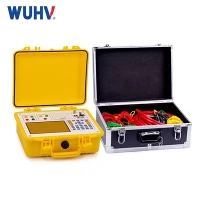


To choose a VLF Hipot instrument for an 80 kV test, you need to carefully evaluate the voltage rating, waveform, load capacity, and diagnostic capabilities of the equipment. Here's a detailed guide:
1. Confirm Test Requirements
Before selecting the tester, you must define:
| Requirement | Your Target |
|---|---|
| Test Voltage (Peak) | 80 kV peak (≈56.6 kV RMS) |
| Frequency | 0.1 Hz (or lower for long cables) |
| Test Type | Withstand only? Or with diagnostics (tan δ, PD)? |
| Cable Type & Length | XLPE/EPR/PILC? Long cables require higher capacitive load support |
| Test Standard | IEEE 400.2, IEC 60502-2, HD 620 S1, etc. |
2. VLF Instrument Selection Criteria
A. Voltage Output Rating
You need a VLF tester rated for at least 80 kV peak output.
Since VLF testers are often rated in RMS, 80 kV peak = 56.6 kV RMS.
Choose a model rated ≥60 kV RMS to ensure margin and duty cycle.
B. Waveform Type
| Waveform | Recommendation |
|---|---|
| True Sinewave | ✅ Best for IEEE/IEC compliance & diagnostics |
| Trapezoidal/Squarewave | ⚠️ Acceptable only for basic withstand, not for tan δ or PD |
Recommendation: Select true sinewave output for compatibility with diagnostic standards (IEEE 400.2, IEEE 400.4).
C. Frequency Range
Minimum: 0.1 Hz for cables up to ~2 km
Optional: adjustable 0.1–0.01 Hz for longer/higher capacitance cables
3. Capacitive Load Rating (µF)
Cables act as capacitors - your instrument must supply enough charge.
Check:
Maximum load (e.g., 1 µF @ 80 kV)
Rated test object length at 0.1 Hz
Use a tester with sufficient load capacity for your longest cable.
4. Test Features
| Feature | Description |
|---|---|
| Auto ramp & hold | Automatically ramps to voltage and maintains it for set time |
| Time settings | 15–60 minute programmable duration |
| Breakdown detection | Immediate test stop and discharge |
| Safety grounding | Internal or external discharge resistors |
| Emergency stop | Essential safety requirement |
| Reporting | Data logging, USB/PC export, built-in memory |
5. Optional Diagnostic Add-ons
| Diagnostic | Use |
|---|---|
| Tan Delta (Dissipation Factor) | Detects insulation aging and moisture |
| Partial Discharge (PD) measurement | Locates insulation defects, weak joints, etc. |
If doing maintenance, not just commissioning, choose a system with diagnostics.
6. Recommended VLF Instruments for 80 kV Testing
| Manufacturer | Model | Voltage Output | Notes |
|---|---|---|---|
| b2hv | HVA90 | 0.1 Hz, 90 kV peak (63.6 kV RMS) | Compact, sinewave, optional tan δ & PD |
| Megger | VLF Sine 62 TD | 62 kV RMS (88 kV peak) | Sinewave, tan δ included, optional PD |
| HV Diagnostics | TD90 or HVA60TD | Up to 90 kV peak | Full diagnostics, USB reporting |
| BAUR | viola TD/PD or frida TD | Up to 80–90 kV peak | Premium diagnostics, serviceable |
| Haefely Hipotronics | 80–100 kV custom units | Custom sinewave units | Industrial class, heavier |
7. Other Considerations
| Factor | Recommendation |
|---|---|
| Portability | For field use, ensure wheeled or rugged transport case |
| Power Input | Check if standard AC or needs generator (for remote testing) |
| Service/Warranty | Ensure local support, calibration, and warranty availability |
Final Selection Checklist
| Item | Status |
|---|---|
| ≥ 60 kV RMS (≈80 kV peak) sinewave output | ✅ |
| Complies with IEEE 400.2, IEC 60502-2 | ✅ |
| Adjustable test time (15–60 min) | ✅ |
| Frequency range down to 0.1 Hz or lower | ✅ |
| Optional Tan Delta / PD measurement | Optional |
| Field-portable with proper cooling | ✅ |
| Safety features (emergency stop, discharge) | ✅ |
| Data logging/reporting | ✅ |