

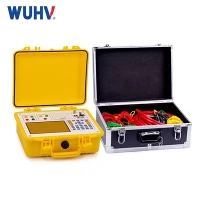


VLF (Very Low Frequency) testing and hipot (high-potential) testing are both methods used to assess the insulation integrity of high-voltage cables and electrical equipment, but they differ in their testing parameters and objectives. Here are the key differences between VLF testing and hipot testing:
VLF (Very Low Frequency) Testing:
Frequency:
Focus: VLF testing operates at very low frequencies, typically between 0.1 Hz and 0.01 Hz.
Purpose: The low frequency allows for extended-duration testing, making it more sensitive to insulation defects and suitable for long cables.
Voltage Stress:
Objective: VLF testing assesses the ability of the insulation to withstand high-voltage stress at very low frequencies.
Voltage Level: The voltage applied during VLF testing is typically higher than the standard power frequency (50 or 60 Hz) but lower than the peak power frequency voltage.
Partial Discharge Detection:
Sensitivity: VLF testing is effective in detecting partial discharges within the insulation.
Integrated Feature: Some VLF testers may have integrated partial discharge detection capabilities.
Applications:
Suitability: VLF testing is suitable for medium and high voltage levels, making it applicable for a wide range of electrical systems and cables.
Purpose: It is commonly used for routine maintenance, preventive testing, and quality control in cable manufacturing.
Test Duration:
Extended Testing: VLF testing allows for longer-duration testing, which is beneficial for assessing the cable's performance over time.
Hipot (High-Potential) Testing:
Voltage Stress:
Objective: Hipot testing is designed to assess the dielectric strength of the insulation by applying a higher-than-normal voltage.
Voltage Level: The voltage applied during hipot testing is typically higher than the standard power frequency voltage, often at a level specified by industry standards.
Frequency:
Focus: Hipot testing is typically performed at the power frequency (50 or 60 Hz) or at frequencies higher than power frequency.
Purpose: The objective is to simulate higher-than-normal operating conditions to identify weaknesses, defects, or breakdown points in the insulation.
Partial Discharge Detection:
Less Sensitivity: Hipot testing is generally less sensitive to partial discharges compared to VLF testing.
Primary Focus: The primary focus is on assessing the overall dielectric strength rather than detecting partial discharges.
Applications:
Common Use Cases: Hipot testing is widely used for routine quality control during manufacturing, commissioning of equipment, and periodic maintenance testing.
Range of Applications: It is applicable to a broad range of electrical equipment, including cables, transformers, motors, and other high-voltage components.
Test Duration:
Shorter Duration: Hipot testing is often conducted for shorter durations compared to VLF testing.
Summary:
VLF Testing: Operates at very low frequencies, assesses insulation at elevated voltages, and is effective for detecting partial discharges. Commonly used for preventive maintenance, quality control, and routine testing.
Hipot Testing: Applies higher-than-normal voltages to assess the dielectric strength of insulation. Commonly used for routine quality control during manufacturing, commissioning, and periodic maintenance testing.
Both VLF testing and hipot testing play essential roles in assessing insulation integrity, but the choice between them depends on specific testing requirements, industry standards, and the nature of the electrical equipment being tested.