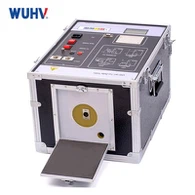

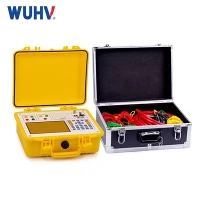


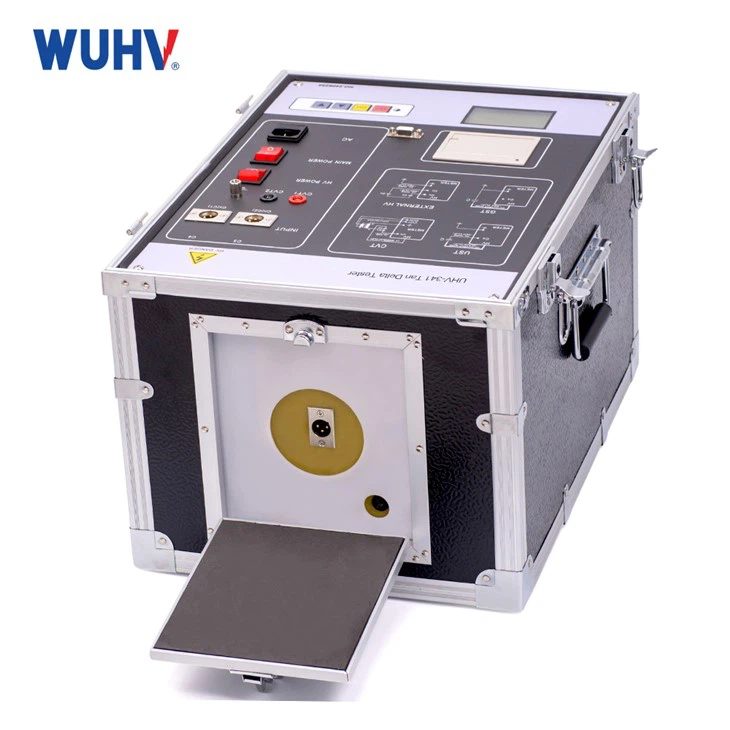

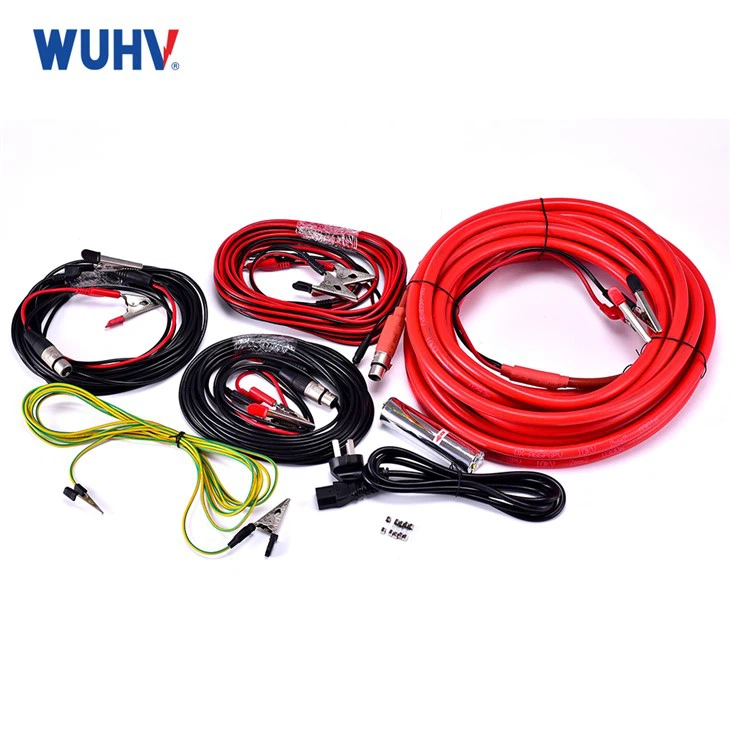
The Dielectric Loss Factor Tester is a specialized instrument used in power systems to precisely measure the dielectric dissipation factor (tan δ) and capacitance (Cx) of insulating materials in high-voltage electrical equipment. It represents an upgraded version of traditional power-frequency (50 Hz/60 Hz) dielectric loss testers, with its core feature being the use of test frequencies different from the power grid frequency to overcome on-site interference.
The Dielectric Loss Factor Tester is indispensable for modern power system insulation diagnostics. By using non-power-frequency testing, it overcomes on-site interference and ensures accurate and reliable measurements of tan δ and Cx. Its anti-interference capability, high precision, safety, portability, and intelligent functions make it essential for grid safety, fault detection, and condition-based maintenance.
Product Parameters
| High voltage output | 0.5~10kV |
| Increasing by 500V for each level, a total of 20 levels, capacity: 1500VA | |
| Accuracy | tgδ: ± (reading * 1.5% + 0.06%) |
| Cx: ± (reading * 1.5% + 5PF) | |
| Resolution | tgδ: 0.001% |
| Cx: 0.001pF | |
| Measuring range | 0.001% |
| Internal high pressure | 3PF~<60000PF/10KV |
| 60PF~1uF/0.5KV | |
| External high pressure | 3PF~1.5uF/10KV |
| 60PF~30uF/0.5KV | |
| Power supply | AC 220V ± 10% 50/60 ± 1Hz |
| Measuring method | a.single frequency: 45(45Hz measuring),50(50Hz measuring),55(55Hz measuring),60(60Hz measuring),65(65Hz measuring) |
| b.different frequency: 50D(45Hz/55Hz measure each time) 60D(55Hz/65Hz measure each time) Automatic frequency conversion | |
| Harmonic adaptation | ≤3% |
| Application condition | -15℃-50℃ Relative humidity<80% |
| Dimension | 460 (L) × 345 (W) × 345 (H) |
| Weight | 35kg |
Main Features of dielectric loss factor tester
Strong anti-interference ability: Use inter-frequency measurement technology, effectively reducing on-site interference such as power frequency electric and magnetic fields.
High measurement accuracy: It can accurately measure the dielectric loss factor (tan δ) and capacitance, suitable for insulation state evaluation of high-voltage equipment.
Fast testing speed: automatically completes voltage boosting, measurement, voltage reduction, and data calculation, improving on-site detection efficiency.
Easy to operate: adopting intelligent control and digital display, the testing process is clear and easy to use.
Complete safety protection: equipped with overvoltage, overcurrent, grounding, and breakdown protection functions to enhance on-site testing safety.
Convenient data management: Supports storage, querying, and printing of test data, making it easy to manage testing records and test reports.
Wide application range: Suitable for insulation dielectric loss testing of transformers, transformers, reactors, bushings, bushing current transformers, and other high-voltage electrical equipment.
Application areas
1. Power industry
Power plants and substations: In power plants and substations, the dielectric loss factor tester is mainly used to test the high-precision measurement of dielectric loss tangent and capacitance of various high-voltage power equipment. Its integrated structure and built-in components such as dielectric loss testing bridge, variable frequency voltage regulating power supply, step-up transformer, and SF6 high stability standard capacitor make the testing process more accurate and efficient.
2. Research institutions
Research on High Voltage Electrical Equipment: The dielectric loss factor tester is suitable for measuring the TG δ and capacitance of high-voltage electrical equipment in workshops, laboratories, and research institutions. Its multiple testing modes (such as internal high voltage, external high voltage, internal standard, external standard, positive connection method, reverse connection method, etc.) can meet different testing needs.
3. In the field of electronic manufacturing
Electronic device design and production: In the design and production process of electronic devices, the dielectric loss factor tester can measure the dielectric loss at different frequencies to obtain the loss characteristics of the dielectric at different frequencies. This has a significant impact on the working state and performance of the circuit.
4. Insulation material testing
Insulation oil test: Equipped with an insulation oil cup and a dielectric loss factor tester, it can test the dielectric loss of insulation oil. It is more sensitive to detecting distributed defects such as overall moisture and aging of insulation or air gap discharge defects in insulation.
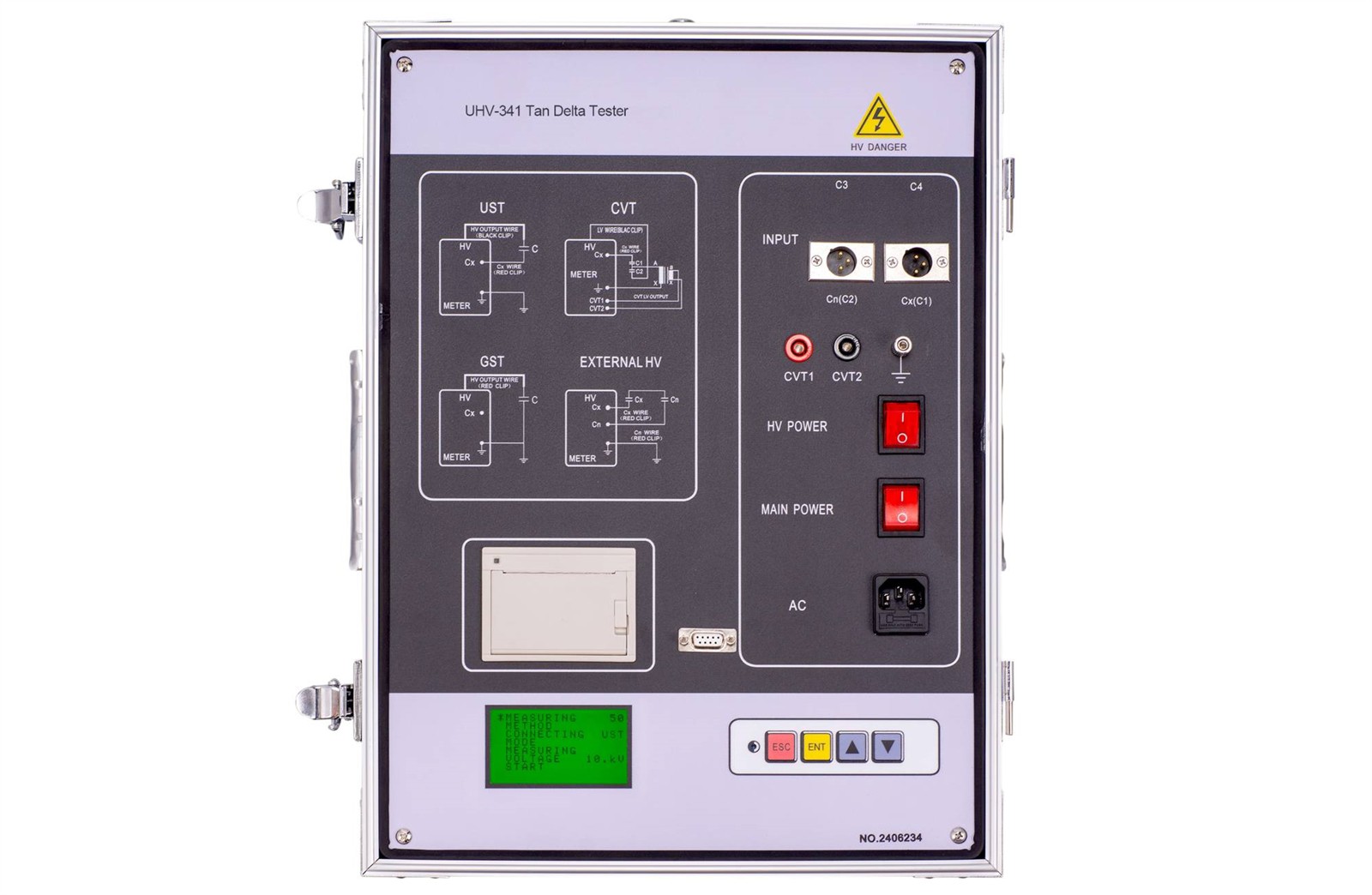

Details


FAQs
What is the role of dielectric loss (tan delta) testing in the UHV power test system?
In UHV systems (1000kV AC / ±800kV DC), dielectric loss factor testing is a basic insulation diagnostic method, mainly used for:
Main transformer insulation aging evaluation
UHV bushing (OIP/RIP) condition monitoring
GIS and circuit breaker insulation assessment
Preventive maintenance
In UHV practice, it is a low-energy but highly sensitive early warning method for insulation defects.
Why do UHV assets rely more on tan delta testing than conventional 110kV/220kV systems?
Main reasons:
More complex insulation structures (multi-layer oil-paper and high-voltage shielding systems)
Higher consequence of failure (large-scale blackout risk)
Higher electric field stress, where small defects are amplified
Therefore, UHV systems rely on combined diagnosis:
Tan Delta + Partial Discharge (PD)
What are the differences between UHV-grade dielectric loss factor testers and standard power-frequency instruments?
UHV equipment typically features:
Stronger anti-interference capability (GIS and high electromagnetic environments)
Higher resolution (tan δ detection down to 10⁻⁵ level)
Variable frequency testing capability (45–65 Hz)
Higher voltage extension capability (up to 12 kV or higher)
Automatic capacitance compensation and shielding design
Why is variable-frequency testing required in UHV field applications?
Because field conditions include:
Strong 50 Hz power-frequency interference
GIS switching noise
Induced voltage disturbances
Value of variable-frequency testing:
Avoids power-frequency interference points
Improves detection of weak loss signals
Enhances repeatability and stability
What is the typical test voltage range of UHV dielectric loss factor testers?
Common configurations in UHV applications:
0.5 kV – 12 kV (standard field units)
Extended high-end versions: 15 kV / 20 kV (laboratory grade)
CVT testing module support (mandatory in UHV systems)
Which equipment is mainly tested in UHV systems?
Key test objects include:
1000 kV main power transformers
±800 kV converter transformers (HVDC)
RIP / RIF high-voltage bushings
GIS insulators and post insulators
Reactors (smoothing and shunt reactors)
Why are UHV bushings a key focus of dielectric loss testing?
Because bushings are:
Oil-paper or resin composite insulation structures
Continuously exposed to high electric field stress
One of the most failure-prone components in UHV systems
An increase in tan δ indicates early signs of moisture ingress or insulation aging.
Can dielectric loss testing replace partial discharge (PD) testing?
No, it is a complementary method rather than a replacement:
Tan δ: overall insulation condition (macroscopic view)
PD: localized defects (microscopic view)
Standard UHV diagnostic practice:
Tan Delta + PD + Insulation Resistance (IR) combined assessment
What challenges does the UHV substation environment present for testing equipment?
Main interference sources:
High-voltage bus electromagnetic fields
GIS switching overvoltage
Ground potential fluctuations
Distributed capacitance of long cables
How is anti-interference achieved in UHV-grade equipment?
Typical technologies include:
Variable-frequency measurement (avoiding 50 Hz)
Phase-sensitive detection (digital lock-in technique)
Dual-channel shielding measurement
Three-terminal / four-terminal compensation methods
Does UHV dielectric loss factor tester support automatic diagnostics?
Yes. Common functions include:
Automatic temperature compensation (oil temperature correction)
Historical trend analysis
Insulation condition index evaluation
Automatic report generation compliant with IEC/IEEE standards
Can it be integrated into UHV test vehicles or mobile laboratories?
Yes, this is a common configuration:
UHV mobile electrical test trucks
On-site GIS testing systems
Integrated high-voltage test platforms
The tan delta tester is typically a core module in such systems.
Does dielectric loss factor tester support CVT testing?
Yes, this is a standard function in UHV-grade systems:
CVT error calibration (capacitive voltage transformer)
Intermediate transformer compensation
High-voltage divider testing compatibility
What is the typical service life of UHV-grade equipment?
10–15 years under normal operation
High-voltage modules typically require maintenance or upgrade after 5–8 years
Is professional qualification required for operation?
Yes. Requirements typically include:
Certified electrical test personnel
Compliance with high-voltage operation standards (DL/T regulations)
We are a professional Dielectric Loss Factor Tester manufacturers in China.We can provide the best professional Dielectric Loss Factor Tester for sales and competitive price. If you are looking for Dielectric Loss Factor Tester supplier, we are a good choice.
Contact us to get Dielectric Loss Factor Tester price.
Hot Tags: dielectric loss factor tester, China dielectric loss factor tester manufacturers, suppliers, factory, Professional Transformer DGA Gas Chromatograph